Not only do I read a huge amount of books about autism; I am also honoured to have been asked to contribute to a growing number of autism affirming and neurodivergent affirming books.
For some books I was interviewed by the author and my story was written by them. For other books I contributed by writing a chapter (or two!) and, for one book, I even chose a recipe! I have also written two of my own books.
I have listed the books I’ve featured in below. I’ve explained how I was featured and noted where to find my contribution.
AUTISTIC MASKING – Understanding Identity Management and the Role of Stigma. Dr Amy Pearson and Kieran Rose. 2023.
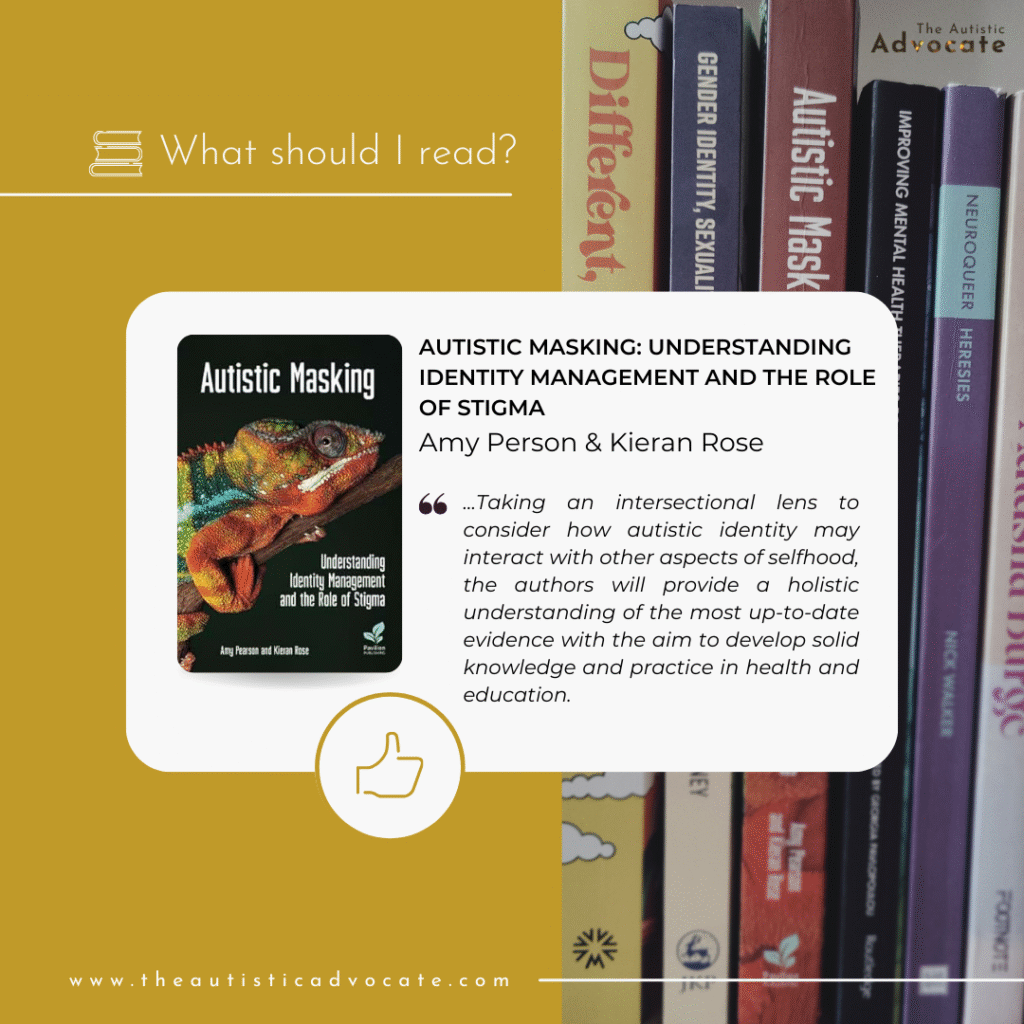
My book! Co-authored with Dr Amy Pearson and published in 2023. There is a full info page about the book here: My Autistic Masking Book
Masking is a form of identity management involving consciously or unconsciously suppressing aspects of identity and action. Often seen in socially marginalised groups, it is found to contribute towards poorer outcomes for autistic people, and is related to higher prevalence of suicidality, exhaustion and burnout, and mental health difficulties. Autistic Masking offers a holistic understanding of the most up-to-date evidence in this field, with the aim of developing solid knowledge and practice in health, education and society.
Written to be accessible to everyday readers with an interest in autism as well as academics and professionals, the book deconstructs the predominant misconception that masking is purely a social strategy to ‘blend in’ with neurotypical (non-autistic) people. The authors consider the social context that facilitates impression management, including an individual’s response to stigma or trauma, and take an intersectional approach to exploring how autistic identity may interact with other aspects of selfhood.
BUY BOOK
Bookshop:
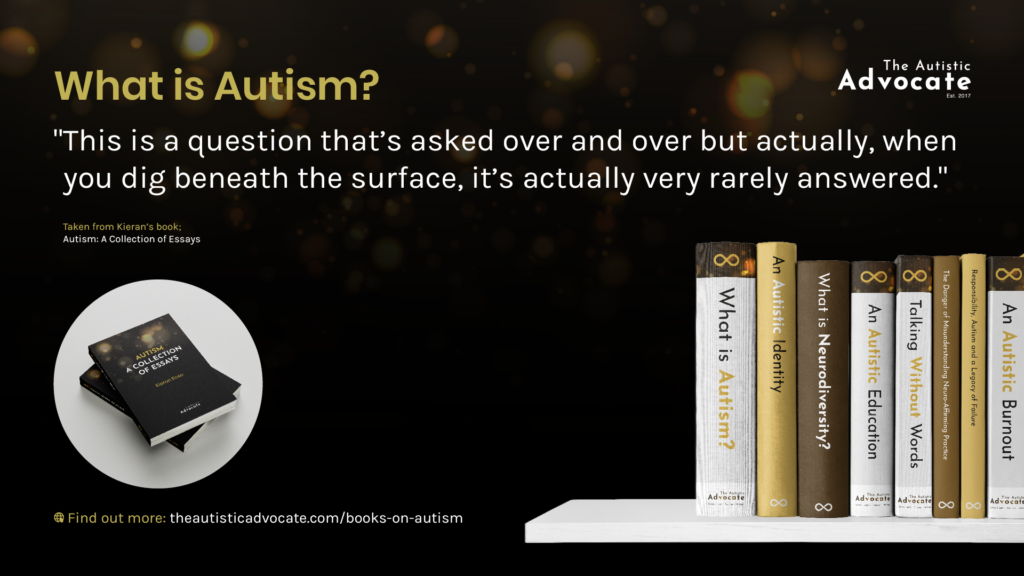
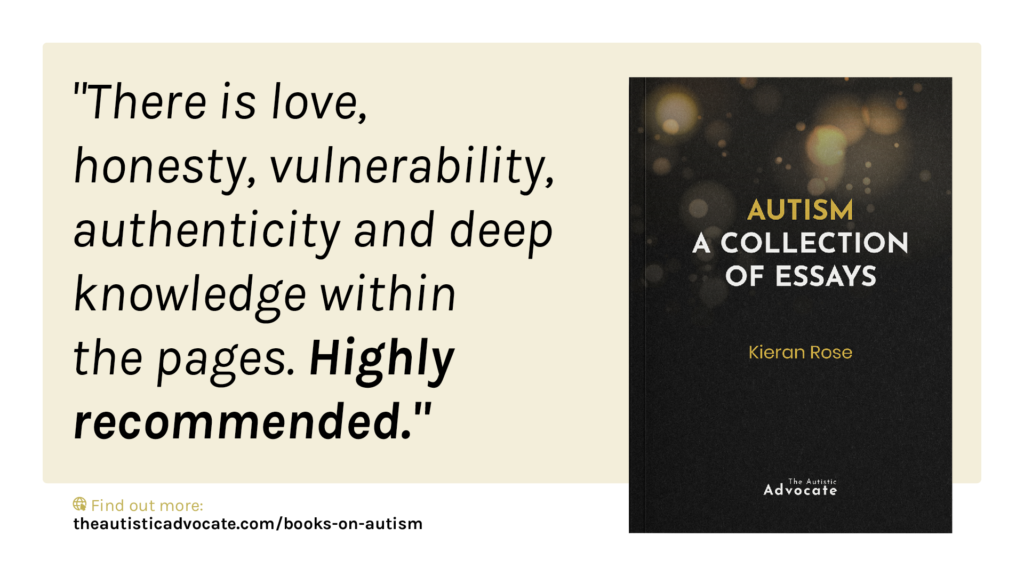
Autism: A Collection of Essays. Kieran Rose (2026)
This is my own book. It’s a collection of 17 of my most read articles from between 2017 and 2025 from my blog.

BUY BOOK
Amazon UK and find out more here too: Autism: A Collection of Essays
The Scale of the Spectrum. Joanna Grace. 2026.
My Contribution. I was honoured to be featured in Joanna’s first book (The Subtle Spectrum, which you’ll find further down this list) so absolutely over the moon to be invited to write the Foreword for The Scale of the Spectrum.
Joanna Grace is a Sensory Engagement and Inclusion Specialist, Author, Researcher, Trainer, TEDx Speaker and Founder of The Sensory Projects.
This book draws on personal stories and insights from autistic people with high and low support needs to present these individuals as equally capable of offering useful and relevant insights, and by doing so argues against the dividing up of some autistic groups from others.
The Scale of the Spectrum is an accessible collection of ‘story pairs’ exploring the commonality of autistic experience. Each story pair tells an account of an autistic person with high support needs and/or their behaviour being misunderstood, alongside an experience of an autistic person with low support needs. Their stories are organised in two sections. In the first, understanding of an autistic person with high support needs is discovered through the experience of a person with low support needs; in the second, an autistic person with low support needs comes to better understand their experience by relating to a person with high support needs. The contributors discuss diverse challenges including food, communication, time management, pain, sensory overwhelm and mental health. Throughout the book, the contributors argue for a unity of overall autistic experience and ask the question of if people at ‘opposite’ ends of the autism spectrum are really so different from each other.
An ideal book for anyone seeking to better understand autistic people and experiences including parents, psychologists, social workers, care workers, teachers and medical professionals.
BUY BOOK
Bookshop:
It Takes All Kinds of Minds: Fostering Neurodivergent Thriving at School. Rachael Davis (Editor), Claire O’Neill (Editor), Sue Fletcher-Watson (Editor). 2025.
My Contribution: I wrote a chapter called ‘Islands of Safety’ which looks at the importance of non-teacher educators in curating felt safety for Autistic children and young people in schools.
It Takes All Kinds of Minds provides an inspiring and accessible introduction to neurodiversity in educational settings, informed by research and real-world experience.
Drawing upon core principles that underpin the neurodiversity paradigm, the book offers a carefully curated collection of chapters exploring many different kinds of minds and how they can best learn and flourish at school. The book is divided into three main parts: Environments, Practice and Pedagogy, and Relationships In and Around School, with each chapter underpinned by core values of care, inclusion, celebration of difference and the collective power of diverse minds. Pioneering contributions help to realise a vision of environments, relational systems and pedagogical practices that are designed for all minds, learners and educators.
Placing a focus on amplifying neurodivergent voices and having a direct impact on practice, this book is essential reading for practitioners at all stages of teacher education and professional development, as well as clinicians and outside agencies that work in partnership with schools.
BUY BOOK
Bookshop:
I Will Die On This Hill: Autistic Adults, Autism Parents, and the Children Who Deserve a Better World. Meghan Ashburn and Jules Edwards. 2023.

My contribution: I wrote the introduction to the section of the book called ‘The Worst of Each Other’ (pages 81-85).
There is a significant divide between autistic advocates and parents of autistic children. Parents may feel attacked for their lack of understanding, and autistic adults who offer insight and guidance are also met with hostility and rejection.
Meghan Ashburn, a mother of two autistic boys, and Jules Edwards, an autistic parent, were no strangers to this tension and had an adversarial relationship when they first met. Over time, the two resolved their differences and are now co-conspirators in the pursuit of disability justice.
This book unites both perspectives, exploring the rift between these communities and encouraging them to work towards a common goal. It provides context to dividing issues, and the authors use their experience to illustrate where they’ve messed up, where they’ve got things right, and what they’ve learned along the way.
BUY BOOK
Bookshop:
The Subtle Spectrum: An Honest Account of Autistic Discovery, Relationships and Identity. Joanna Grace. 2021.
My contribution: I have a short session entitled, ‘Identity: The Masking Paradox’ (pages 29-31).
Am I autistic, or is autism something I suffer from? Should I come out, to my friends, to my family, to the people I work with? Should I drop the mask? How can I explain my experience to a neurotypical world?
The Subtle Spectrum offers an exploration into the postdiagnostic landscape of autism and the transformative journey of one woman, from her awareness of difference, through acceptance, to an embracing of autistic identity and beyond as she questions the cultural identity of autism.
Joanna’s narrative is enriched with insights from a range of diverse contributors, creating a reflective opportunity for people to gain a better understanding of the experience of being autistic. With a focus on relationships built across a neurodiverse divide, the book considers topics as broad as mental health, work opportunities and abuse, weaving theory and research with lived experience to give true insight into the life of an autistic person, both pre- and post- diagnosis.
Written with a raw and engaging honesty, this is a crucial read for anybody who identifies as autistic as an adult or teenager, or anyone looking to support somebody exploring diagnosis. It will also provide an invaluable insight for social workers, educators and relationships counsellors working with autistic people.
BUY BOOK
Bookshop:
Improving Mental Health Therapies for Autistic Children and Young People: Promoting Self-agency, Curiosity and Collaboration. Georgia Pavlopoulou, Laura Crane, Russell Hurn, Damian Milton. 2024.
My contribution: I co-authored two chapters. Chapter 5 featured in the section related to autistic mental health and was co-authored with Julia Avnon (pages 58-68). The chapter title was; Understanding low mood, shutdown and burnout in autistic children and young people. Chapter 12 featured in the section related to developing curiosity in service delivery and transformation and was co-authored with Dr Rosyln Law (pages 149-136). The chapter title was: When the helping professions hurt – the need to build trust and make sense of each other in the therapy room.
This unique, collaborative book, featuring contributions from autistic and non-autistic experts, presents cutting-edge thinking on mental health and service transformation in relation to autistic children and young people (CYP) and their families.
Investigating how to implement collaborative approaches to supporting autistic CYP’s mental health, this book considers ways for professionals to share power and co-design models of support, promoting self-agency and supportive environments for autistic acceptance and wellbeing. Each chapter includes reflections and vignettes from autistic CYP and allies, key questions and thinking points for readers to consider. The book also includes a link for an e-library with multimedia material with the top take aways for clinicians such as animations, flyers and recorded interviews.
The book will be of immense interest to individuals working with autistic CYP and their families in mental health at any level.
BUY BOOK
Bookshop:
Our Autistic Lives. Alex Ratcliffe. 2020.

My contribution: I wrote a chapter (page 81-87) about my experiences of being autistic during my 30s. I wrote it under the pseudonym Skywalker.
This collection of narratives from autistic adults is structured around their decades of experience of life, covering 20s, 30s, 40s, 50s, 60 and 70s+. These are varied and diverse, spanning different continents, genders, sexualities and ethnicities, yet the author highlights the common themes that unite them and skilfully draws out these threads.
Each chapter is based on accounts from one age group and includes accounts from people of that age, giving an insight into the history of autism and signifying how gaining a diagnosis (or not) has changed people’s lives over time. The book is about ageing with an autistic mind and helping the listener find connections between neurotypical and neurodiverse people by acknowledging the challenges we all face in our past, present and future.
BUY BOOK
Bookshop:
The Autism Friendly Cookbook. Lydia Wilkins. 2022.
My contribution: I contributed a recipe for a roasted Greek lamb leg (page 270-271).
The Autism-Friendly Cookbook was created by journalist Lydia Wilkins for autistic adults and teens to turn to when cooking for friends, lacking inspiration, or on those low-energy days. With recipes to suit any occasion, the book is written in clear, jargon-free language which makes ‘the obvious’ obvious.
Recipes are categorised by meal with additional guidance on the level of energy needed to tackle them, with options for low-energy or meltdown days, or days when you’re able to take on a new challenge. They contain adaptations and options to suit different dietary needs including vegetarian, vegan, gluten-free and dairy-free, and additional modifications for those who are sensory seekers, sensory avoiders or who want to expand their repertoire in the kitchen.
With contributions from individuals within the autistic community and options for quick meals, special occasions and more. With autistic people at its heart, the book also contains helpful tips and advice for parents and teachers looking to find out more.
BUY BOOK
Bookshop:
Tender: The Imperfect Art of Caring. Penny Wincer. 2021.
My contribution: Penny interviewed for the chapter of her book called, ‘Ableism’. My section is called ‘Another way of looking at disability, (pages 82-83)
We are all likely – at some point in our lives – to face the prospect of caring for another, whether it’s a parent, child or partner. It is estimated that there are 7 million people in the UK caring for loved ones. And yet these are the unpaid, unsung people whose number is rising all the time.
In Tender: the imperfect art of caring, Penny Wincer combines her own experiences as a carer with the experiences of others to offer real and transformative tools and insights for navigating a situation that many of us are either facing or will face at some time.
Penny Wincer has twice been a carer: first to her mother, and now as a single parent to her autistic son. Tender shows how looking after oneself is a fundamental part of caring for another, and describes the qualities that we can look to cultivate in ourselves through what may otherwise feel to be an exhausting task.
Weaving her lived experience with research into resilience, perfectionism and self-compassion, Penny combines the stories of other carers alongside those who receive support – offering an often surprising and hopeful perspective.
BUY BOOK
Bookshop:
Learning From Autistic Teachers: How to Be a Neurodiversity-Inclusive School. Dr Rebecca Wood. 2022
My contribution: I wrote a chapter for the second section of Rebecca’s book called, ‘Understanding Autistic Teachers’. My chapter is Chapter 4 and is called, ‘Inclusion Isn’t Just For Children: The Marginalisation of Autistic Educators Due to Albeism in Schools’ (pages 61-70).
In this strikingly honest collection, developed from a pioneering new research project, autistic teachers and other autistic school professionals share their stories of the challenges and successes of their careers. Contributors challenge assumptions and stereotypes whilst highlighting the unique strengths autistic staff can bring to schools when their own needs are accommodated.
The book explores exclusion and identity, understanding and acceptance, intersectionality and facilitating inclusion. It also celebrates the positives that come with being an autistic teacher, such as relating to neurodivergent pupils and conveying passion and enthusiasm for a subject through intense interests, or demonstrating particular skills in school leadership. It examines how workplace set up can sometimes exclude autistic individuals and lead to skilled teachers and those in other education roles, including visiting professionals, leaving the profession, and sets out the accommodations that can prevent this from happening.
BUY BOOK
Bookshop:
AUTISM POSITIVE BOOKS: MY FULL LIST
This list of books I’ve featured in is only a small part of my much more comprehensive list of Autism Positive Books. Which, at the time of publishing this article, contained around 180 books. 180+ Autism Positive Books
The list is free to access. I also have a paid-for version wihich is beautfully designed as an ebook which you download and/or print. It comes complete with book descriptions, categories, a spreadsheet and space to write your own comments. Your purchase is a one-off but gets you ALL future version at no extra charge. which you can find here: Recommended Autism Positive Books: ebook/catalogue)

I appreciate that a list of 180 books can be daunting, so I also have two ‘Top 10’ lists.
TOP 10 NON-ACADEMIC BOOKS ABOUT AUTISM
Just click the image to be taken to my list of non-academic books about autism.

TOP 10 ACADEMIC BOOKS ABOUT AUTISM
Just click the link to visit my list of academic books about autism.

If you’ve found this article useful you can support my work by donating any amount from $3 (about the same as a coffee – mine’s a caramel latte please!).
I know not everyone wants, or needs, one of my training courses, but I often find people will read one of my free articles and want to say ‘thank you’. And this is a really easy way to do that. It also supports me to keep being able to create new, free content and keep my older, free content up-to-date. It also allow me to keep my website ad-freel My Autism FAQs page is a good place to start if you’re new to my work and want to explore more.
Thanks for you support – it means the absolute world. Kieran x
JOIN KIERAN’S MAILING LIST (for infrequent, but useful, updates!)
And, as a thank you for joining, you’ll get a 10% off code emailed to you which you can use on Kieran’s on-demand autism training and ebooks (including the Recommended Autism Books catalogue).
You might also be interested in my online, on-demand autism training
I have a full range of autism affirming, on-demand training available on my website: Browse Online Autism Training

Got more questions about Autism?
If reading this article has given you more questions then my Autism FAQs is a great place to point you in the right direct to get answers (and most of where I direct you is to free-to-access resources!).

2 replies to "Autism Affirming Books I’ve Featured In"
Absolutely wonderful resource! 🌟 Thank you for sharing such a comprehensive and thoughtfully curated list of autism-affirming books, along with your personal contributions and insights. Your dedication to promoting neurodiversity and amplifying authentic autistic voices is truly inspiring. This page is a treasure trove for anyone seeking to learn, understand, and support the autistic community in a positive and empowering way. Keep up the amazing work—you’re making a real difference!
Wonderful resources. Thank you!