In this article Kieran Rose discusses why we need to be critical of the concepts of EBSA and School Refusal; especially in relation to our autistic children.

The terms ‘School Refusal’, ‘EBSA’ (Emotionally Based School Avoidance), and ‘EBSNA’ (Emotionally Based School Non-Attendance) all rely on a foundational fiction: that school is a safe and appropriate place for all children.
That when a child does not attend, the problem lies within the child. That distress is a dysfunction to be managed, rather than a communication to be honoured.
For many children – particularly Autistic, ADHD, or otherwise Neurodivergent – school is not just uncomfortable, it is unsafe. Not always in overtly traumatic ways (though sometimes it is), but in the quieter, chronic erosion of safety: through sensory assault, relational rupture, masking demands, institutional gaslighting, microaggressions, surveillance, punishment for authenticity, and relentless pressure to conform to norms that were never designed with them in mind.
Safety, in most school environments, is conceptualised through the adult gaze. It is measured by order, silence, and the absence of disruption. But these are performative markers, not lived experiences. They do not reflect whether a child feels safe – only whether they appear manageable. For neurodivergent children especially, safety is not the absence of visible chaos. It is the presence of felt-safety: an internal state grounded in predictability, attunement, cultural resonance, and the freedom to self-express without fear. It is not built through policy, but through relationship. And it cannot exist where a child is being watched more than they are being understood. The child who is silent may not be settled. The child who is compliant may not be calm. When adults confuse the appearance of safety with its reality, they become complicit in sustaining harm that looks like care.
Felt-safety is not merely the absence of threat – it is found in the space between cognitively knowing you are safe, and emotionally feeling that you are safe – it is the presence of emotional, sensory, cultural, and psychological grounding, and it is completely unique to the individual. In the context of an Autistic child in school, felt-safety is experienced when a child’s environment is not only non-threatening, but actively affirming of their way of being, it is not experienced by attempting, honestly or performatively, to give them what they need, but by actually understanding and validating who they are. It is a state of embodied permission to exist without defence. Unlike performative safety – which satisfies safeguarding protocols and adult perceptions – felt-safety lives in the child’s nervous system. It is the difference between appearing calm and being calm, between acting regulated and feeling secure. Without felt-safety, learning is not possible. Only survival is. Schools that focus on visible compliance mistake the absence of disruption for the presence of connection – but for Neurodivergent children, this is often the precise moment they begin to disappear. If safety is not felt, then education becomes endurance.
But even that harm is not experienced equally. The consequences of being unable to cope, unable to conform, or unable to endure are shaped by more than neurology. They are shaped by race, gender, class, culture, disability, and language. A white Autistic child might be framed as anxious or quirky. A Black Autistic child might be seen as oppositional, aggressive, or dangerous. A non-speaking child may be seen as “non-compliant” or “incompetent”. A Trans ADHD child may be cast as unstable. A child from a poor, single parent household may be dismissed as a behavioural issue before distress is even considered. The child’s protest is not read on neutral terms – it is interpreted through the intersecting lenses of systemic bias. This is why intersectionality is not an academic accessory. It is a necessary framework for recognising how compounded marginalisation, rooted in bias, assumption, stigma and mythology alters both the experience of school-induced trauma and the way it is sanctioned, silenced, or criminalised.
The language of “refusal” assumes a shared cultural narrative – one that centres white, Western, individualistic ideals of success, participation, and obedience. But these ideals are not universal. They are colonial artefacts that frame difference as dysfunction and dissent as deviance. For children from immigrant families, for racialised and minoritised children, for those whose cultural identity does not map onto the dominant school narrative, the concept of “refusal” is not just inaccurate – it is a distortion. Distress may be read through racialised tropes: the angry Black child, the ungrateful refugee, the disobedient Muslim girl. Language barriers become diagnostic delays. Dress codes become instruments of cultural erasure. Curriculum becomes a mirror that reflects nothing back. For these children, school is not neutral. It is an institution of assimilation – and “school refusal” is often a refusal to surrender identity.
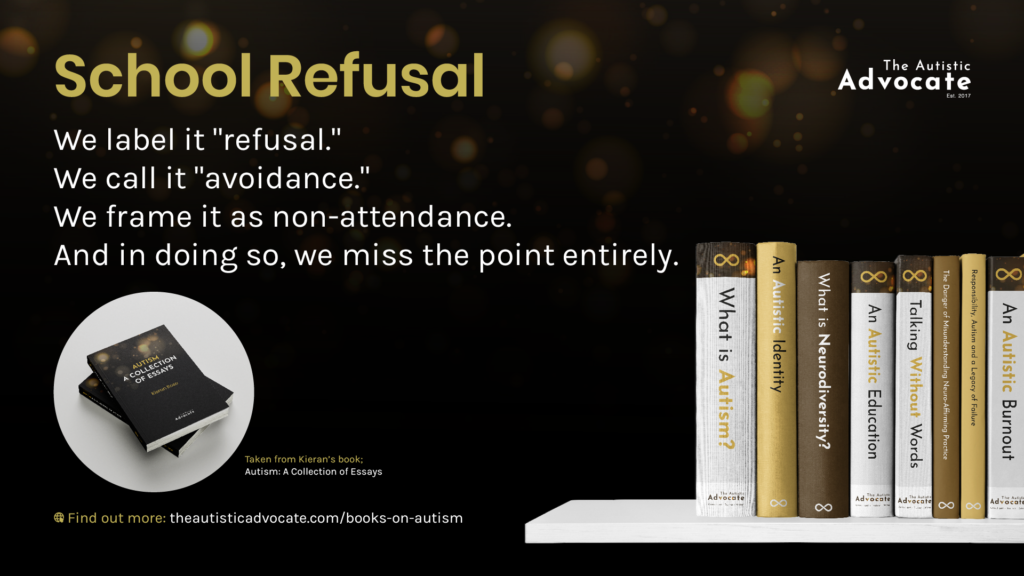
And yet, when a child cannot tolerate that harm, when they say “no, not today, not like this”, we label it “refusal.” We call it “avoidance.” We frame it as non-attendance. And in doing so, we miss the point entirely.
This essay is contained in my book, ‘Autism: A Collection of Essays‘ along with 16 other essays from my blog. Including a new introduction, preface and a Foreword from Dr Amy Pearson. Find out more here; Autism: A Collection of Essays

These terms obscure the structural nature of harm by pathologising the child’s response. They shift attention away from the environment and back onto the child – their anxiety, their fear, their ‘attachment issues’, their ’emotional difficulties’ – as if failing to endure a harmful system is a flaw. As if collapse is evidence of inadequacy, rather than the consequence of prolonged survival without support.
They reflect the education system’s and educators profound absence of understanding – not just of emotional wellbeing, but of neurodivergent experience. They erase the realities of attentional difference, sensory overload, communicative divergence, burnout, and the emotional labour of constant self-monitoring and identity management. They ignore how masking enables the hiding of distress until it becomes uncontainable, or how the projection of distress is too often perceived through other lenses, like ‘poor behaviour’, or ‘dysregulation’. How behaviour is often not communication, but containment, or release. How many children appear fine until they burn out and they fall apart.
In: ‘Autistic Masking: Understanding Identity Management and the Role of Stigma‘ (2023), I, and Durham University’s Assistant Professor of Developmental Psychology, and world-renowned autism researcher, Dr Amy Pearson, define Masking as:
“The conscious or unconscious suppression or projection of aspects of self and identity, and the use of non-native social strategies.”
Masking is not a coping tool; it is a survival response to stigma, trauma, and a chronic lack of felt-safety. For neurodivergent children for whom masking takes the form of suppression, it becomes a form of camouflage in unsafe environments, an armour they are forced to wear in order to be seen as acceptable. But armour is heavy, and children are not meant to carry it daily. The cost is profound: emotional exhaustion, identity fragmentation, and the delayed recognition of distress – by adults and by the child themselves. Worse still, many school systems reward this type of masking: the meek and the mild. The quiet child is praised. The overwhelmed child who holds it together until they get home is framed as “fine.” Engagement is measured not by wellbeing but by palatability – and children are rewarded not for being safe, but for looking safe. For the children whose mask presents like big behaviours, big movements, big emotions, who fills the social niches that draw attention – it is no different. They are just more obviously identified as a problem. Their energy is spent, their safety is sought, by projecting a version of themselves that others with power expect and recognise, fulfilling a prophecy with a legacy of equal exhaustion, burnout, and trauma. For either group, intersectionality returns as a key framework in understanding, especially for potentially or actually multiply-marginalised children and young people, that layers of marginalisation shape the person’s experiences, and responses in unique ways, contributing to even more multi-faceted masks.
Professionals operating within these frameworks are often working from a label-focused model. If a child is undiagnosed, they are “difficult.” If diagnosed, they are “complex.” Either way, the child becomes a problem to be managed, not a person to be understood. Reasonable adjustments are offered as charity, not rights – and when they don’t work (because they are often superficial and reactive), the child is blamed for being effectively ‘treatment resistant.’ The environment remains unquestioned. The system remains intact.
This is the machinery of behaviourism in action. The child’s body becomes the site of intervention. Their behaviour becomes the unit of analysis. Their distress becomes something to reframe, retrain, or extinguish. The logic underpinning it is one of control – not care.
Behaviourism doesn’t ask what a child needs. It asks what will make them compliant. And compliance becomes synonymous with success.

What many schools call “structure” is often the disciplinary gaze in disguise. It is the constant surveillance of bodies, postures, voices, and reactions – a web of control that trains children to self-monitor, to shrink, to stay within the lines. This gaze is institutional, not incidental. It manifests in behaviour charts, house points, forced eye contact, corridor monitoring, ‘expected’ and ‘required’ behaviours, and exclusion and isolation for ‘non-engagement.’ It punishes movement, emotion, difference. For Neurodivergent children, it teaches that being watched is a condition of being included – and that visibility is always conditional. The cost is hypervigilance. Shame. Disconnection from one’s own body. In this system, the gaze is not neutral. It disciplines both the child and their identity – making them readable only if they are reducible. Only if they are tame.
The curriculum tells children what matters – and by omission, who doesn’t. It reflects the epistemologies of dominant culture: white, Western, neurotypical, middle-class. When neurodivergent children, racialised children, disabled children, or those from diverse linguistic backgrounds do not see themselves represented – or worse, see themselves framed only as problems to be solved – it sends a clear message: your knowledge does not count. This is epistemic injustice, named by Miranda Fricker as a form of epistemic domination that ensures the child remains the object of study, never the author of truth. What is taught, how it is taught, and whose voices are centred all serve to either affirm or erase identity. The curriculum does not just educate. It disciplines, it controls, it steers and directs. It teaches children how to think, feel, speak – and most damaging of all, how to disappear the parts of themselves that do not align with the standard narrative.
When schools insist that children “use their words,” they rarely pause to ask: whose words? Whose cadence? Whose rhythm of expression? Language is not neutral – it is cultural, embodied, and deeply personal. For many neurodivergent children, especially those who are non-speaking, semi-speaking, or communicate through movement, sound, AAC, or silence, the school environment invalidates their communication identity. They are not simply unheard – they are unseen. The dominant model of communication in schools assumes speech as the gold standard, and anything outside of it is treated as deficient. But communication is not just a skill; it is an extension of identity. To pathologise how a child communicates is to pathologise who they are. This is Epistemological Violence, the kind enacted on the body, where expression must be translated into a form deemed acceptable before it is even considered real.
Distress is not always met with curiosity. More often, it is met with suspicion. Diagnostic gatekeeping – the process by which children are denied access to identification, support, and affirmation – functions as a mechanism of exclusion. For working-class children, for racialised children, for gender-diverse children, the threshold for referral is higher. The benefit of the doubt is scarcer. And when a diagnosis is eventually secured, it is often used not to liberate but to contain – with needs reframed as inherent deficits, and distress absorbed into the condition. Referral becomes a privilege. Diagnosis becomes a passport.
But understanding should not be contingent on paperwork. And when it is, the children who fall through the cracks are not missing – they are being erased.
When a child stops attending school, the finger rarely points at the system first. It points at the parent – especially the mother. Especially so if she is disabled, racialised, single, or neurodivergent herself. This redirection of blame is not incidental. It is systemic. It allows the school to protect its image by outsourcing accountability. Parenting becomes a site of moral scrutiny, and attendance becomes a test of adequacy. Families are offered “support” laced with judgement. They are asked what they’ve done wrong, why they haven’t corrected the child’s behaviour, why they haven’t made them more palatable. This is not partnership. It is pathologisation by proxy. And it compounds intergenerational trauma – especially for parents already navigating their own histories of exclusion, knowingly or not.
To centre trauma without also naming joy is to concede too much to the systems that harm us. Liberation is not just the absence of trauma. It is the presence of joy, curiosity, connection, and play. It is when a child no longer has to choose between safety and authenticity. When their difference is not just accommodated but celebrated. Resistance can look like stimming freely. It can sound like a child speaking in echolalia without being interrupted. It can feel like a soft space, a trusted adult, a quiet refusal. These are not trivial moments. They are acts of reclamation. They say:
I am still here. And I am still me.
Children and young people internalise the belief that they are the problem. That their distress is unreasonable. That their body’s response to harm is a form of failure. They are blamed for their own suffering, told they are “too sensitive,” “too emotional,” “not resilient enough.”. That they refuse, or avoid, that the issue is perpetually centred in them.
This is victim-blaming in institutional form – a steady drip-feed of invalidation that teaches children to mistrust their own signals.
When children are told, repeatedly, that their reactions are wrong, their instincts flawed, their needs excessive – they do not just learn to mask:
They learn to doubt the very architecture of who they are as human beings.
This is not just psychological harm. It is a fracturing of identity. Especially for Autistic and ADHD children, whose understanding of self is still forming, school becomes the site where authenticity is punished, and performance is rewarded. Over time, many come to believe that being themselves is unsafe – and that survival requires self-erasure. They grow into adults who apologise for their existence, who second-guess their every response, who mistrust joy because it was never freely given. Identity, once something innate, becomes something negotiated, camouflaged, and curated for acceptability. This is not resilience. It is rupture.
And this harm does not grow in isolation. It is cultivated within an ecology of stigma, as perfectly described by this powerful piece of research exploring the experiences of Neurodivergent young people.
An ecology of Stigma layered and systemic atmosphere that surrounds the child long before they stop attending. It is found in the misperceptions and biases of the staff about the child’s fundamental identity, in the language used to describe them in staff rooms and reports. It is in the lowered expectations, the raised eyebrows, the detentions for “disruption” when the child is simply trying to survive. the lack of recognition of just how exhausting it is to consistently enter environments managed and curated by people who have no fundamental idea about who you or what you need, or how you need to exist, beyond the recognition of all of those things and the total framing of them that you are a problem.
Someone with ‘special needs’. Who must be shoehorned into a system and institution that only perceives its own needs.
It is in the misinterpretations of behaviour, the absence of curiosity, the over-reliance on diagnostic labels, and the constant centring of adult convenience. In this ecology, the child learns that their body, their communication, and their needs are problems to be corrected – that they are safest when they disappear. It is not just the moment of non-attendance that harms them. It is the thousand tiny moments before it, made invisible by a system that considers its own intentions to be enough.
The adults positioned as protectors – teachers, teaching assistants, SENDCO’s, mentors, safeguarding leads: the ones that care – are often framed as the relational anchors in a child’s school life. But in coercive systems, those anchors become restraints. When adults are tasked with enforcing attendance, rewarding compliance, and reporting deviation, they become agents of the very harm children are trying to escape. This is not about intent. It is about function. The adult who gently encourages a child back into a classroom might be perceived as kind – but if the classroom is a source of trauma, then that kindness becomes coercion.
And when they do speak, children are often gaslit, their reasons for not attending dismissed as exaggeration or excuse. They are pressured to “push through,” “cope better,” “give it another try.” But pushing through pain is not resilience. It is self-betrayal rehearsed daily. And the cost is burnout, not just physical exhaustion, but deep, neurological depletion. These are not disengaged children. They are children in survival mode.
School systems are built for momentum: keep going, push through, stay on track, attend, attend, attend, or you will fall behind!
But this linear, relentless pace leaves no space for recovery. Even when a child is visibly struggling, rest is not offered – it must be justified. Days off trigger scrutiny. Decompression is reframed as avoidance. Breaks are earned through performance, not granted through need. Even the spaces intended for regulation – time-out rooms, sensory spaces – are often surveilled, restricted, or conditional. For neurodivergent children living in chronic stress, this absence of rest becomes a secondary trauma. They are asked to process harm while still inside the system causing it. And when they can’t, they are punished for their exhaustion – as though recovery from systemic failure is a personal responsibility.
Surveillance doesn’t end with adults. Children quickly learn to police one another – to enforce the codes of conformity passed down through reward systems and subtle hierarchies. Neurodivergent children often find themselves under the gaze of their peers, expected to perform normative sociality, suppress stim behaviours, participate in banter, or tolerate bullying framed as teasing. Noncompliance becomes social suicide. Even those who aren’t bullied may be made spectacles – praised for “being brave” or “trying hard,” reinforcing the idea that their presence is exceptional, not expected. This peer surveillance is not neutral. It reproduces the values of the system and extends its reach into every corner of the child’s day. It is not enough to sit still. One must sit still like everyone else. This is how stigma is socialised – not just taught but enforced.
We must name what is happening here for what it is:
School-Induced Trauma
And we must ask why we don’t name it as such.
What is protected by avoiding this term?
Whose comfort is preserved when we pathologise the child rather than interrogate the system?
Where does the power reside?
The answer is clear: a system that sees itself as the solution – and therefore refuses to be accountable as the cause.
Naming trauma would demand reflection. It would demand reparation. It would demand change.
So instead, the burden is placed on the child. Again.
Over time, this constant invalidation calcifies into internalised ableism – a belief that their needs are wrong, their bodies broken, their way of being less than. And this belief doesn’t stay in school. It follows them into adulthood, shaping how they relate to others, how they ask for help, how they see themselves. It becomes a lens through which life is distorted, limited, dimmed.
Trust, too, is eroded. Not just in adults, but in the system itself. In language. In care. In the idea that anyone will listen without trying to fix, correct, or coerce. Many of these children will go on to avoid not just school, but services altogether. They are labelled “hard to reach” – when what they’ve learned is that reach is often a prelude to harm.
And for those who continue to be dragged into classrooms, therapies, or attendance plans, the outcome is not inclusion. It is endurance.
A slow, attritional form of harm. Where the cost of appearing functional is complete internal disintegration. These are children who learn to perform, not flourish. Who learn that proximity to normality is safer than authenticity. Who are left with fewer spoons, fewer choices, and more barriers than when the entire process began.
This is not care. This is a system that creates trauma and teaches children to call it help.
The goal is not inclusion. It is liberation.
Because when a child stops going to school, we should not begin with a plan to get them back.
We should begin with a question:
What are they trying to get away from?
That change will not come from attendance strategies or new acronyms. It will come from reflection – deep, uncomfortable, necessary reflection.
For professionals reading this: this is not an attack on your intent. It is an invitation to examine the frameworks that shaped your training, your policies, your default responses. What would it mean to see a child’s non-attendance not as a challenge to fix, but as a message to understand? What would it take to shift from managing distress to dismantling the systems that cause it? And are you willing to listen – truly listen – to what children are telling you, even when it contradicts everything you were taught?
Let us return to the language we began with: School Refusal, EBSA, EBSNA.
Say them, interrogate them, taste them. How do they fit in your mouth now? How do they sit within a framework that has empathy at it’s heart? Because you are using one of those, right?
These are not impartial descriptors. They are diagnostic mirrors that reflect the system’s discomfort, not the child’s truth. They reduce protest to pathology, survival to avoidance, and trauma to emotional difficulty. They allow schools and professionals to respond without responsibility – to catalogue distress without ever having to confront its cause.
If we truly wish to support children, we must begin by abandoning, the dehumanising rhetoric, and the language that blames them for suffering they did not create.
We must replace it not with new acronyms, but with new understanding.
Because children are not refusing school. They are refusing harm.
And it is time we stopped asking what’s wrong with them – and started asking what’s wrong with the environments that demand their invisibility to function.
Liberation begins here: not in defending the system, but in refusing to perpetuate the damage it causes and denies responsibility for.
Read More About Autism and Education
Many parents struggle with their Autistic children’s education and the Education system generally.
There many reasons for this, ranging from poor quality Autism education and the way the education is set up.
PLEASE READ MY ARTICLES FOR A MORE DETAILED DISCUSSION:
An Autistic Education and my article ‘Autism and Attachment Theory’ is also relevant.
The terms ‘School Refusal’, ‘EBSA’ (Emotionally Based School Avoidance), and ‘EBSNA’ (Emotionally Based School Non-Attendance) all rely on a foundational fiction: that school is a safe and appropriate place for all children. I cover this in much more detail in my article: School Refusal or School-Induced Trauma? Rethinking EBSA, EBSNA, and the harm we call help
I also look at the fallacy of SEND in ‘There’s No Such Thing AS SEND.’
I have also written chapters in a number of books designed for educators. You’ll find them listed in the ‘Kieran Featured section’ of my Recommended Autism Books Catalogue.
This essay is contained in my book, ‘Autism: A Collection of Essays‘ along with 16 other essays from my blog. Including a new introduction, preface and a Foreword from Dr Amy Pearson. Find out more here; Autism: A Collection of Essays

If you’ve found this article useful you can support my work by donating any amount from $3 (about the same as a coffee – mine’s a caramel latte please!).
I know not everyone wants, or needs, one of my training courses, but I often find people will read one of my free articles and want to say ‘thank you’. And this is a really easy way to do that. It also supports me to keep being able to create new, free content and keep my older, free content up-to-date. It also allow me to keep my website ad-free. My Autism FAQs page is a good place to start if you’re new to my work and want to explore more.
Thanks for you support – it means the absolute world. Kieran x
Keep in touch with Kieran Rose, The Autistic Advocate
Training and ebooks from Kieran
My Meltdows, Shutdowns and Burnout in Autistic Children and Young People in Education Settings is a good companion to this article.

I have a full range of autism training and ebooks on my website; starting from just a few dollars and all priced to be affordable.

Got more questions about Autism?
If reading this article has given you more questions then my Autism FAQs is a great place to point you in the right direct to get answers (and most of where I direct you is to free-to-access resources!).

1 Response to "School Refusal or School-Induced Trauma? Rethinking EBSA, EBSNA, and the harm we call help"
Wow, this is eye opening. Made me cry with relief. I feel like I finally understand what my granddaughter is going through. I’m sharing with her dad. Will read of your work. Thank you Kieran!