In this article Kieran Rose discusses the dangers of misunderstanding neuro-affirming practice.
Overview:
There’s been a lot of debate lately about whether “neuro-affirming” practice is just another form of brain determinism.
It isn’t.
The real problem isn’t the Neurodiversity Paradigm, it’s Neurodiversity-Lite: the watered-down, performative version that borrows the language of affirmation but strips it of meaning. It pathologises, reduces people to “brains,” and in doing so, ends up reproducing the very harm it claims to resist.
True neuro-affirming practice rejects determinism. It centres lived experience, identity, agency, and the messy realities of human lives. It isn’t about boxing people in, it’s about creating conditions where they can thrive as themselves while also challenging the systems that punish difference.
In my new piece, I unpack the risks of conflating “neuro-affirming” with Neurodiversity-Lite, and why careless critiques of neurodiversity often miss the point entirely.
There has, of late, been a lot of debate about what “neuro-affirmative” means, and whether it risks slipping into what is known as ‘determinism’.
There is a specific, recent post by a well-known, largely followed, and genuinely well-regarded and ‘trusted’ Clinical Psychologist who works predominantly in Education, which has sparked me to write this. In that post, the author declared themselves as not a ‘neuro-affirming’ practitioner. I won’t name or link to them here, not through fear for myself, but because I genuinely don’t want to send traffic that way, and also end up encouraging a pile-on, when there has already been considerable pushback.
Writing something along the lines of what follows here has been percolating in my brain for a long while. And there’s no need to have read the post I referenced above, as my article isn’t a direct response to that or any one single post, article, book or author, but a response to a whole unsettling and troubling narrative which is gaining more visibility over time.
My percolation started years, ago, as the idea of determinism is not a new one, it has been around as long as neurodiversity discourse has existed, and discussions about it are available in book, research, blogs and online discussion, but, if anything, the article that follows began being written in my head after the publication of a series of articles published in December 2024 in a leading ‘anti-psychiatry’ magazine. Those articles critiqued the Neurodiversity Paradigm, and said critique, in my view, highlighted the collective authors lack of understanding of the narratives within neurodiversity discourse, and their belief that the paradigm is a well-understood and universally agreed-upon, concrete thing. Again, I am not linking to those articles, they have had enough traction and have reared their head again on the above post I mentioned, they do not need any more traffic.
With regards to the idea of determinism, I think it’s worth engaging with this debate and the viewpoints being discussed carefully, because beneath the disagreements there are definitely some shared concerns. However, there are also, I firmly believe, some fundamentally important misreadings of truly neurodiversity-aligned work, and solid disagreements to be had.
‘Brain-based determinism’, the phrasing often used in this debate, is a short-hand for ‘biological determinism’ applied specifically to the medical notion of neurology. It is problematic and should be critiqued. For a definition:
It is a reductionist belief that a person’s behaviour, abilities, and life outcomes are predetermined by their brain biology.
In the framing of ‘autism’, references to Autistic neurology are often taken to mean a fixed, innate “brain type” that dictates what someone can or cannot do, often discouraging curiosity about environment, culture, trauma, or identity; and assuming that someone cannot do anything differently ever, because who they are is fixed and rigid.
I absolutely agree that reducing a person’s experience to “it’s just how your brain works” is limited, unhelpful and frankly, incorrect.
People are not reducible to their brains, and no identity can be explained through biology alone. Social context, relationships, culture, trauma, and history all matter in shaping lives. So when practice collapses everything into neurology-as-brain, it risks discouraging curiosity and limiting how people understand themselves.
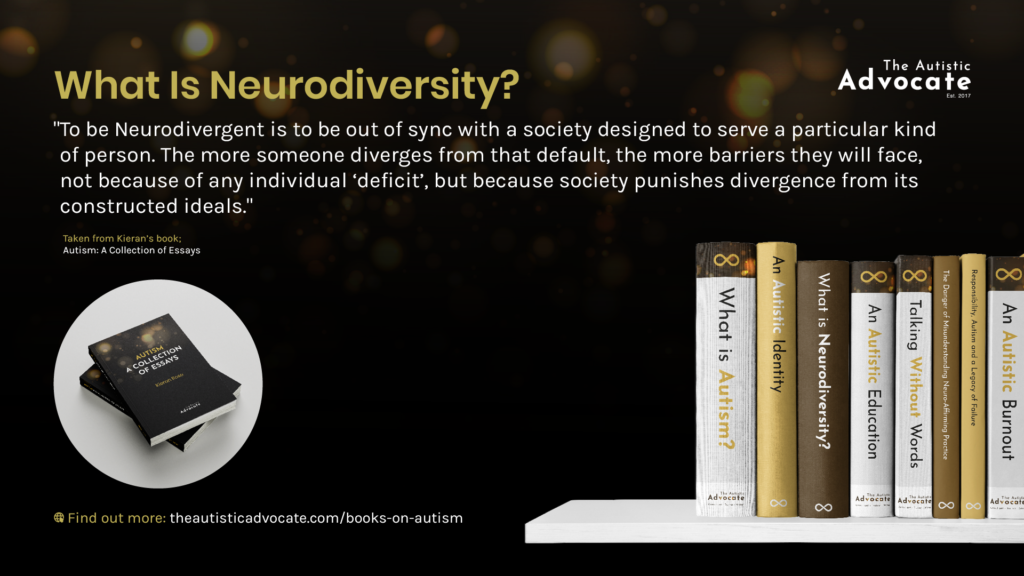
This essay is contained in my book, ‘Autism: A Collection of Essays‘ along with 16 other essays from my blog. Including a new introduction, preface and a Foreword from Dr Amy Pearson. Find out more here; Autism: A Collection of Essays

While the concern about determinism is absolutely valid, where I would diverge from the arguments being presented lies in locating the risk.
I consider suggestions that the concept of neurodiversity and therefore neuro-affirming practice adopts brain-based determinism as problematic, and in dire need of unpacking.
I believe that perspectives like this are framed around a misconception of what Neurodiversity means, a misconception of what neuro-affirming practice is supposed to look like, and an assumption that just because some people do ‘something’, that this is definitively what it is, and is supposed to look like.
I think the larger problem here is the assumption that the critics understand the neurodiversity paradigm fully, and secondly, that the examples highlighted by those critics, that claim neuro-affirming practice, also understand the neurodiversity paradigm and are meaningfully following it.
The risk, for me, lies not in the Neurodiversity Paradigm itself at all, but in what I and others have named for decades as Neurodiversity-Lite:
A superficial, diluted and performative version of the Neurodiversity Paradigm, that adopts Neurodiversity’s language without its substance, and which is followed and practiced by those who have adopted the concepts superficially, without understanding them meaningfully, if at all. It (and by ‘it’ I mean practice and understanding that falls under this banner of Neurodiversity-Lite) is an interpretation of neurodiversity only, not a definitive understanding of it and is not practice that reflects meaningful understanding.
Neurodiversity-Lite presents itself as progressive and affirming, but in practice it often continues to pathologise, individualise, or manage neurodivergent people within existing systems, and/or falls into superficial support mechanisms that assume that who you see in front of you is as a result of their ‘brain’. It focuses on positivity and surface-level inclusion rather than confronting structural power, systemic injustice, or the lived realities of oppressed. It often veers from one extreme of too much pressure, into another of no pressure at all. There is no middle ground that allows for space, but also allows for boundaries, challenge, progression and change. And, yes, practices that follow these Neurodiversity-Lite narratives, unfortunately, can and often do, fall back on brain-based determinism.
It is important to recognise that Neurodiversity-Lite, unfortunately, is everywhere. If you see people use ‘Neurodiversity’ they usually are, unfortunately and often unwittingly, referring to Neurodiversity-Lite. It has become as much as a problem as medicalised, pathologising, behaviourist, deficit-based practice, popularised by employment and recruitment industries, promoted and reinforced on social media platforms (LinkedIn, especially, is a hotbed of Neurodiversity-lite and performativity), and now embedded across multiple fields of practice.
I often find, and this is definitely the case in the examples of posts and articles I’ve referenced in this article, that when criticisms of either Neurodiversity itself, or the concept of neuro-affirming practice (usually based on determinism) appear, what gets critiqued as “neuro-affirming practice” tends not be neuro-affirming practice at all, but Neurodiversity-Lite practice that considers itself neuro-affirming.
The critics assume they are critiquing something, when they are actually critiquing something else entirely. One thing has been conflated for another.
It is ironic that there are proponents of Neurodiversity that are just as vocal at critiquing and calling out Neurodiversity-Lite discourse and practice, but they are never mentioned, or if mentioned, often rarely and misrepresented. That these proponents are very often the very scholars at the heart of Neurodiversity discourse, and yet their opinions are not really referenced at all is interesting to me. I think this shows that the critics are not engaging with the literature meaningfully, nor making any real attempt, if any, to engage with those writing it. Their preconceived bias trumps and often prevents actually meaningful connection with the paradigm.
I can understand why the conflation might occur. Without cultural competency around the neurodiversity narrative and the discourse held within, it is easy I suppose, from the outside, to miss the distinction between the Neurodiversity Paradigm and Neurodiversity-Lite or not even know that this dichotomy exists.
A lack of cultural competency can present in a variety of ways, one of which might be how words are used. The Double Empathy Problem (Milton, 2012 – see here for an easy introduction) is, I believe, a very real factor in this process, as it is in many processes where two cultures meet.
When the distinction between Neurodiversity and Neurodiversity-Lite goes unseen, it’s usually accompanied with the assumption that everyone involved is talking about the same things in the same way, especially when multiple groups are using the same or similar language. Cultural competency would allow for at least the acknowledgement of the possibility that different groups might be using the same words, but those words might carry different meanings for those different groups.
For example:
The assumption that those using a term such as “Autistic neurology” must be operating from the same brain-based determinism that psychology is used to.
From a medicalised perspective, which psychology adopts, neurology is taken to mean only the brain as an anatomical organ: the stuff of MRI scans, neurons, and lobes. Through that narrow lens phrases like “autistic neurology” justifiably sound like claims that there is a fixed brain type waiting to be identified, which understandably raises fears of biological essentialism. Added to this is the concept of ‘neurotypes’ – another commonly heard term, and one which I find problematic when used to mean there are ‘types’ of brain, which becomes a narrative reinforcer in this interpretation.
But for those Neurodivergent scholars and practitioners modelling the Neurodiversity Paradigm in its truer context, this fully medicalised use of neurology is not what we mean. That this may not be understood suggests that those scholars and practitioners need to communicate meaning better, but it also means that those interpreting need the cultural competency to engage with the discussion more meaningfully. Communication is a two-way street and assuming makes an ASS out of U and ME.
As I’ve written in both ‘What is Neurodiversity?’ and ‘What is Autism?’, (Which I really recommned you go and read in order to dig into these ideas futher), the “neuro” in neurodiversity refers not to the brain as an ‘organ’, but to the whole ecology of neurological processing: the integrated relationship between brain, body, sensory systems, physiology, and mind, and how these are shaped by and interact with culture and society.
Neurology is not just an organ in a skull; it is the living system through which a person perceives, processes, and responds to the world. In that sense, Autistic neurology is distinctive not because it marks out a static “brain type,” but because it identifiably takes in and uses sensory information differently, fuelling distinctive patterns of perception, attention, emotion, communication and movement which invite a very different experience of the world, and which shapes identity in significant ways – all of which in turn is interacted with by external forces and interpretations – an ecology between inside processes and outside processes, no different to any other human, the drive force underneath which is this difference in processing. To say “Autistic neurology” in this sense is not to claim determinism, but to acknowledge that being Autistic runs through every layer of embodied experience. It is a short-hand for the ecological, relational, and cultural, not just simply biological. It is the lens through which bodily systems, experiences, processes and identity can be interpreted for and by Autistic people, underpinning personhood and core being.
As eloquently described here:
“Being Autistic runs through our neurology in the same way that words or streaks of colour run through sticks of sweet seaside rock…any effort to pull the writing out of the rock is not going to end well for anyone concerned.” Kavanagh et al, 2025)
I used this quote deliberately, as it was also used in a recent post by a critic of neuro-affirming practice as a way to evidence that self-declared Neuro-affirming practitioners are engaging in brain-based determinism.
From a viewpoint uninformed about Autistic culture, and the reclamation and conceptual broadening of existing language, this could serve as a perfect example with which to critique deterministic narratives about ‘Autistic neurology.’ However, if you are informed about Autistic culture and the reclamation and conceptual broadening of existing language, you could apply the context of who is writing it, why, and what might their meaning be here. You might then interpret the same sentence completely differently and apply completely different, but connected, meaning to it.
The same with ‘neurotype’, which is an extension of the above, a broader term referring to a group of people experiencing things that are recognisable traits of that group, referring to the shared experience of what I described above. A type of people with a neurological experience generally specific to that group; not that there is a definitive and literal type of brain that we should all be able to spot on a scan.
It is ironic how so many of these critics are doing the thing that Autistic people are accused of – being incredibly literal and rigid in their thinking.
So, it all depends on how you are defining and using the terms like ‘neurology,’ and whether you are culturally competent enough to recognise that multiple interpretations of the same word exist, or at least acknowledge the possibility that those multiple interpretations might exist.
The ecological use in neurodiversity-aligned work is not a distortion of bio-medical language, but a deliberate resistance to expand on that reductionism. To insist on only the biomedical definition is itself a form of narrowing, and to me, highlights that the people doing so, as I have previously mentioned, aren’t embedded in the culture, and aren’t meaningfully engaged in critical Neurodiversity studies, Neurodivergent writing, and discourse about the Neurodiversity Paradigm.
So why are we reinterpreting language instead of making up new terms?
Sometimes new terms are created or explored, but ultimately this comes back to embedding yourself in the culture again, and understanding broader disability and marginalisation discourses. People without power rarely get to create the language that is used to describe their own experiences. Testimonial injustice is very real. The fact that we do have a handful of words and phrases which better describe Neurodivergent experiences, and which have come from Neurodivergent people, is testament to decades of protest, work and toil from hundreds, if not thousands of people. Most of whom are Autistic (there is very little narrative in relation to non-autistic Neurodivergent experiences) and most of whom are white, globally north and English-speaking. If the white people can’t make much of a movement, we know there are barriers. I also, think that based on the criticisms and the standards neurodivergent movements and scholarship are held to in comparison to the all the stigmatising and marginalising work that exists, if we did start making new words up, very few people would pay attention anyway. And where would we put them, other than in our spaces, or spaces that we have contributed to forging, few of which are public?
As per the limited and privileged interpretation of ‘Neurology’, similar issues arises with the concept of ‘neuro-affirmative’.
It has been mischaracterised as telling children “this is how your brain works, and nothing can change.” in some quarters, I agree. But this is Neurodiversity-Lite in practice and is not representative of what the Neurodiversity Paradigm calls for.
Neuro-affirmative practice should be rooted in the Neurodiversity Paradigm: resisting deficit framings, rejecting pathologisation, rejecting determinism, and centring identity and lived experience as a way of increasing agency and autonomy, equipping someone with not only the ability to adapt and be challenged, but also to engage on their own terms safely and meaningfully. As I argued in ‘What is Neurodiversity?,’ to be Neurodivergent is to be out of sync with a society designed to privilege certain kinds of people. Neuro-affirmative practice should therefore mean not confining people to static stories about their brains, but exploring their selves, finding commonality with others who experience things similarly and who have similar processes, and challenging the societal structures that punish divergence; creating conditions where people can flourish as themselves, and indeed recognise, support and, if necessary, attempt to change patterns of behaviours that are detrimental to that person’s wellbeing.
It’s also important to recognise that “neuro-affirmative practice” is not a settled or universally agreed term. There is a lack of consistency, different people hold different opinions. There are competing definitions and even contradictions within the field, which is a sign of both the evolving nature of Neurodiversity as a paradigm, but also the evolving nature of practice within that. The paradigm itself has not had the privilege of hundreds of years to develop into a field of practice or ideology like psychiatry or psychology. It does interest me though, to reiterate a point, that the standard Neurodiversity appears to be held to, is not the same standard that psychiatry or psychology is held to. And critics from those fields appear to forget the vast divisions and arguments that occur within those fields, despite their years of progress. Convenient that., isn’t it…
Again to reiterate, just because a piece of work labels itself neuro-affirming does not make it so, nor does it make it representative of all neurodiversity-affirming practice. As I mentioned earlier, some practices that adopt the language continue to reproduce deficit models or deterministic framings using the narrative of Neurodiversity-Lite. Reading across the field therefore does, and should, reveal inconsistencies, but those inconsistencies reflect the process of contestation and co-option, not the essence of the neurodiversity paradigm itself, which again, is explored in: ‘What is Neurodiversity?’
It may also help to distinguish between what we mean by ‘neuro-affirming’ and ‘neuro-inclusive’ practices.
Neuro-affirming practice should be a stance: a principled commitment to rejecting deficit models, centring identity, and challenging systemic barriers, allowing change, challenge and flourishment. Neuro-inclusive practice should then be the application of that stance in the real world: the active restructuring of environments, policies, and relationships so that neurodivergent people are not merely accommodated, but able to thrive, grow and develop. Built on the concept that knowing oneself allows one to understand what agency they have, rather than accepting some form of world-based determinism – that this is all there is and it shall not change. In this sense, affirmation without inclusion risks staying abstract, while inclusion without affirmation risks becoming tokenistic. The relationship between the two is similar to awareness and acceptance, or equality and justice: one is passive recognition, the other is active transformation. Affirmation creates the conditions, but inclusion makes them real.
Diagnosis complicates this picture further.
Autism is not a natural category; it is a shifting, human-made construct that has changed significantly across time and cultures. In ‘What is Autism,’ I wrote that:
“Autism is an observational construct used to pathologise people on the basis of misunderstood human behaviour.”
There is no test, no scan, no visible sign of any difference beyond that which is seen observationally, which is why brain-based determinism is a flawed concept.
This is one of many reasons why I argue that there is no such thing as autism, only Autistic experience. That is a nuance though, which many find hard to grasp.
Autism is a label created through professional observation, but Autistic experience is lived reality – which is why it is so important that we understand how identities are constructed and through which mechanisms because Autistic identity is not autism, and autism is not Autistic identity.
The diagnostic construct of autism is absolutely problematic, I teach the history of autism, and have spent years studying both it and along with it the parallel and intertwined evolutions of psychiatry and psychology, child development, eugenics, and the DSM, alongside so many connected narratives. However, while the way the diagnosis and the narrative around autism has been constructed is deeply flawed, limited and problematic, that doesn’t mean that there is no science that we can point to to evidence that Autistic experience is genuine and actually happening.
At the risk of making some brain-based determinism, we have lots of beyond-theoretical evidence now that does point to definitive and connected and overlapping differences in how Autistic people work in terms of language acquisition and deployment, sensory and emotional processing, attentional styles, movement, perception and much, much more. We can also say with relative certainty that these differences are as a result of lots of interconnected mechanisms occurring, a constellation, as some are describing; which are then intersecting with personal experiences and personal identity development, along with ecological experiences.
While Autistic neurology might not ‘look’ different on an MRI scanner, it is identifiably doing some things differently to different degrees in Autistic people, and those differences are collectively experienced as a largely definable group – to say otherwise would be incorrect.
All of which is to say that while brain-based determinism is problematic, we can’t entirely throw the baby out of the bath water because genetics are a factor.
While diagnosis of autism may be arbitrary, contested, and political, that does not render it fully meaningless.
A rarely discussed factor among clinicians is that separate to diagnosis being a clinical label, and gatekeeper to understanding and potential support and services, it is also an entry point into community, identity, and explanation. I personally find this to be problematic: someone should not have to go through the process of proving they are ‘disordered’ in order to understand that they are Autistic. But my idealism and the reality of the world we currently live in, which demands that diagnosis in so many ways, are not aligned. And currently the world we live in demands the pathological identification of a condition or disorder as conditional to understanding a person’s needs. So the world, and not I, wins.
The Neurodiversity Paradigm holds this tension deliberately, where it has to, recognising both the harms of diagnostic systems and the importance of identity, and how in the present world, the two often become married and entwined, with diagnosis being the gatekeeper to aspects of identity.
To deny that in the name of resisting determinism, especially when based on a misconception of what some people are doing in the name of something they might not fully understand or wilfully ignore, risks erasing precisely what makes people real to themselves and to one another. To do so reeks of privilege and an unnuanced understanding of the factors involved intersectionally.
This is why it feels misleading to me, to see people suggest that the field is dominated by “brain-based determinism.” On the contrary, as mentioned, work by many neurodivergent scholars, writers and contributors, from Professor Nick Walker to Dr Monique Botha, Dr Robert Chapman, Dr Amy Pearson, Sonny-Jane Wise, Dr Steven Kapp, Dr Damian Milton, and many, many, many others, humbly including myself; has been precisely about rejecting determinism. The emphasis of this discourse has been consistently focused on oppression, identity, intersectionality, systemic injustice, and the ecological nature of neurodivergence, not just a study in brains and the determinism that they are what they are, without ever changing.
There are literal whole bodies of work that take years of study, which couldn’t possibly be downloaded, read and the totality of the discourse absorbed in a brief period of time, as has been suggested in some quarters. There is a reason why critical neurodiversity studies and critical autism studies courses are starting to appear. In order to truly understand this narrative requires the ability and time to dissect all this meaningfully, it requires engaging with others who are doing the same and whom are ahead of you in some ways, in this process.
The risk of determinism exists of course, particularly in “Neurodiversity Lite” adaptations, but it is not the defining feature of neuro-affirmative practice as some have suggested, if the Neurodiversity Paradigm is being followed.
To suggest otherwise risks flattening the very nuance that has been carefully developed over those years of scholarship and activism and contributes little but the feeding of critics of the Neurodiversity Paradigm, who often show a poor understanding of the paradigm they are critiquing in their determination to prove their biases, through some kind of ‘gotchya’.
In short, the real choice is not between “autism is neurological” or “autism is environmental.” That is a false binary.
As I outlined in ‘What is Neurodiversity?’ and expanded in ‘What is Autism?,’ neurodivergent experience emerges from the dynamic interplay of embodiment, mind, culture and power. It cannot be reduced to brains, nor can it be separated from the societal norms that pathologise difference, it is both and neither and more. It is precisely because of this richness that the Neurodiversity Paradigm has become such a vital framework: it refuses reductionism in any direction, whether biological or environmental.
As I said right at the beginning of this piece, there are definitely shared concerns, but first we have to have a common language about what it is we are sharing concerns of.
This all requires an educated stance, and it requires nuanced debate.
If we want to critique neuro-affirmative practice, let’s do so in a way that engages with what it actually says, and by understanding the Neurodiversity Paradigm in its most honest (and admittedly still evolving) form. Not by doing so in a way that takes what lots of people think neuro-affirming practice and the Neurodiversity Paradigm are, and assuming that as the reality of what they are.
There is a genuine conversation to be had about how to avoid “neurodiversity lite,” about the risks of determinism, essentialism, and about how to keep conversations about identity, power dynamics, and lived experience at the centre. But we can only have that conversation if we stop misrepresenting one another’s terms, and if we acknowledge there is pre-existing nuance we might have missed.
People with large platforms (much larger than my own), built on followers made vulnerable by circumstances beyond their control, wield enormous responsibility.
That responsibility requires constant reflection. Shock-value headlines and sweeping declarations followed by poorly informed or unnuanced takes may generate attention, but they also generate controversy, consternation, and anxiety. When a “trusted professional” declares themselves “not a neuro-affirming practitioner,” it may be provocative, but in a world where marginalised people are already battered by mis- and disinformation, and that battering is increasing, not decreasing; such declarations, especially when not fully informed, complicate more than they clarify. All they do is just feed the negative noise, and unfortunately, whether wittingly or unwittingly, they contribute to stigma and harm.
If someone lacks the cultural competency to understand what is being communicated, has not deeply examined on their personal and professional biases, and has not grasped the nuances of what they critique, then they should reflect carefully on whether they are qualified to be declaring definitively on what something is or isn’t, and they should reflect carefully as to what they are critiquing, and whether their criticism is justified. This applies to everyone.
I am concerned at this lack of reflection across the board, but especially the positioning done by so many of these critics, as I have been specifically discussing. Some of these critics have made the case that their professional status makes them best qualified to comment on the impact of neuro-affirming practice and neurodiversity more broadly. While there may be an element of truth to that, and without denouncing all professional practice as worthless, I would also posit that professionals have historically, and continue to be, the source of the overwhelming majority of harm experienced by Autistic people. I would add to that that historically professional teachings, particularly around all forms of Neurodivergence have been built upon research that is now being heavily critiqued with a great many flaws, particularly around autism and ADHD. So, I think that declaring or arguing that you are best placed to be a gatekeeper because of your professional status, could be considered slightly less than humble, and definitively problematic, and egotistical.
There is a final irony here.
In warning against brain-based determinism, many of these critiques end up enacting neurological imperialism themselves. By assuming that only psychological or biomedical framings of “neurology” are valid, by making claims of being best placed to decide what is neuro-affirming and what is not, due to their qualifications and professional status, they collapse ecological and identity-centred accounts back into biology and exert power. This is precisely the reduction they accuse neuro-affirming practice of making. The determinism they claim to resist is reproduced through the very lens they apply, and have the power to apply with ‘authority’.
By misreading neuro-affirming practice as determinism, the lens they apply is of itself deterministic.
If brain-based determinism reduces everything to biology, what we see here could just as easily be called psychology-based determinism: the assumption that professional training confers the right to define the terms of the debate, and that only one disciplinary lens can be valid…
Like all things, the concept of Neuro-affirming practice deserves critique, but it deserves critique, which is unbiased, reflective, nuanced, holds meaningful understanding, and is also, above all, accurate.
***
In the spirit of double empathy, there is always the possibility that I have interpreted positions incorrectly and unintentionally misrepresented some viewpoints; or indeed that, despite my point at the beginning that this is not about one person particularly, but about a particular ongoing and longstanding narrative of criticism, informed by a number of books, articles, journal papers and social media posts across years – that someone might read this and apply it solely to themselves.
In light of this I am very happy to make corrections if my attention is drawn to anything. I would also recommend though, that anyone who may feel that they have been misrepresented also considers their communication, wring and arguments, and reflects on why so many may have misinterpreted their words.
Anticipated critique of this piece
It is important to acknowledge that this piece itself will not escape critique. Some may suggest that by distinguishing between Neurodiversity and Neurodiversity-Lite I am attempting to gatekeep definitions. Others may argue that expanding the meaning of “neurology” into something ecological stretches language too far, or that by criticising determinism as a misreading I underestimate how easily it creeps into practice. Some may say I rely too heavily on scholarship, or that my distinction between autism as a construct and Autistic identity as lived experience is contradictory. And others will argue that my framing risks presenting a binary when practice in reality is much messier.
These are not trivial concerns, but I would suggest they reinforce rather than weaken the core arguments made here. So I have attempted to anticipate what I would assume to be some of the greater concerns about what I have written, and provided responses to them:
You’re positioning yourself and aligned scholars as arbiters of “true” neurodiversity. That’s gatekeeping!
The distinction I’m making is not about controlling who “owns” neurodiversity, but about recognising that there’s a difference between faithful engagement with a paradigm and superficial adoption of its language and ideology. Every movement faces co-option: feminism, anti-racism, queer liberation. Naming Neurodiversity-Lite is not about gatekeeping, it’s about calling attention to dilution and misuse that actively undermines the paradigm’s emancipatory intent. Critique is welcome, but it needs to engage with the body of scholarship and lived experience that actually defines the paradigm, rather than its watered-down imitations.
Expanding “neurology” beyond its biomedical meaning muddies communication and creates confusion.
Language is always contested and evolving, especially when marginalised groups reclaim it. Terms like “queer” or “crip” were redefined against dominant usage, and so too is “neurology.” To insist on the biomedical definition alone is itself an act of reductionism and, I argue, neurological imperialism. Our ecological use doesn’t erase biology, it situates it within the embodied, relational, and cultural realities that biomedical framings exclude. Misunderstanding isn’t inevitable; it’s a call for cultural competency.
You externalise determinism as a problem of misreading, but it can creep into genuine neuro-affirming practice too.
I agree. Any practice risks sliding into determinism, especially under systemic pressures. My point is that when determinism does creep in, it represents a departure from the Neurodiversity Paradigm, not its essence. Naming that risk is part of the work. To critique neurodiversity-aligned practitioners who accidentally reproduce determinism is fair. But to suggest the paradigm itself is deterministic is to misrepresent what it actually says.
You lean heavily on scholars; that’s academic elitism
The Neurodiversity Paradigm was and continues to be co-produced by scholars, activists, Autistic advocates, parents, and community organisers. My references to scholarship are not meant to elevate academics above community voices, but to highlight the work that has articulated these ideas most clearly and systematically. Many of the scholars I cite are themselves neurodivergent and embedded in community activism, many of them were and are an integral part of attempting to discuss and formalise what is being said. What I resist is not grassroots interpretation, but the dismissal of both scholarship and lived experience by those who haven’t meaningfully engaged with either.
You say autism isn’t real but Autistic identity is, aren’t you smuggling determinism back in?
This isn’t a contradiction, it’s a distinction. Autism is a diagnostic category, arbitrary, historically contingent, shaped by psychiatry and culture. Autistic experience, however, is a lived reality: people experience consistent patterns of perception, attention, movement, and embodiment that are socially recognised and shared. Diagnosis is one way that reality is named, albeit imperfectly. Acknowledging genetic, sensory, or attentional patterns doesn’t make us determinist; it makes us honest about embodiment while situating it within ecology, culture, and identity.
You criticise others for provocation, but you sometimes use sharp rhetoric yourself.
Yes, my tone is pointed at times, but there’s a difference between rhetorical emphasis and shock-value headlines. I’m not using provocation to bait or dismiss, but to highlight irony and power imbalance. If I occasionally use sharper phrasing, it’s to illustrate the stakes of the debate. The difference is that my critique engages with substance and literature, whereas the declarations I’m critiquing often bypass that altogether, despite claims otherwise.
Your binary ignores the messy middle where most practice sits.
The binary is a heuristic, not an ontological truth. Of course practice exists along a spectrum. The point of naming “Neurodiversity-Lite” is to identify a cluster of tendencies: superficial, co-opted, performative; that undermine the paradigm. Between faithful practice and outright dilution, there is indeed a messy middle. But without naming the ends of that spectrum, it becomes impossible to analyse where practices drift or why some reinforce oppression while others resist it.
You are wrong because this organisation says “XXXX”, this person said “XXXX”.
Pointing to one author (even me), organisation, or policy, and holding it up as the representative stance is a methodological flaw. Every movement has disagreements, schisms, and contested interpretations: psychology, psychiatry, behaviourism, and psychoanalysis all contain multitudes of clashing voices, yet no one suggests that one journal article defines the whole field. The neurodiversity paradigm is no different. Yet it apparently must be held to a higher standard than all those fields, despite the fact that it is still evolving, and disagreement is evidence of a live, maturing discourse, not of incoherence. To cherry-pick one stance and present it as universal is to ignore the breadth of scholarship and practice that already exists, and to misrepresent a paradigm by reducing it to one convenient example. If critics want to engage meaningfully, they must engage with the full conversation, not a handful of fragments.
TL/DR / Common Questions
Isn’t neuro-affirmative practice just brain determinism?
No. The Neurodiversity Paradigm explicitly rejects determinism. The risk of “your brain is just like this” thinking comes from Neurodiversity-Lite adaptations, not from the paradigm itself. Some practitioners may call themselves neuro-affirming, that doesn’t mean that they are, or that they are following the Neurodiversity Paradigm.
But doesn’t “Autistic neurology” mean a fixed brain type?
Not here. In biomedical contexts, neurology often means only “brains.” In neurodiversity-aligned contexts, neurology refers to the whole ecology of body, mind, sensory system, physiology, and culture. Recognising “autistic neurology” in this sense isn’t determinism but instead acknowledging lived reality.
I’m confused, if autism isn’t real, how can there be Autistic people?
As I wrote in ‘What is Autism?’: autism is a diagnostic construct, arbitrary and shifting, externally observed and subject to great biases and assumption. Being Autistic is lived internal and external experience, identity, and culture. It is not a denial that something is happening in Autistic bodies, Autistic experience is very real and meaningful, but the thing we call ‘autism’ is a problematic, stigmatising and poorly constructed explainer for that. On the other hand, diagnosis may be political and flawed, but it can also provide language for belonging. The neurodiversity paradigm deliberately holds both these truths.
Isn’t identity a trap for children, making them think they can’t change?
Identity is very real, and it is not a box; it is an evolving facet of life shaped by neurology, embodiment, and culture. Denying identity in the name of avoiding determinism is its own form of harm.
Why not stick with the scientific definition of neurology?
Because that narrowness is itself part of the problem. Defining neurology as “brains only” is a form of neurological imperialism, it reduces lived experience to what can be measured. The ecological definition expands the frame without denying biology.
Isn’t “neuro-affirmative” itself unclear or contradictory?
Yes. There isn’t one settled definition, and not everything that labels itself “neuro-affirming” actually is. Some uses reproduce deficit models or determinism. The contradictions show the field’s contestation and co-option, not the essence of the paradigm itself.
Is there a difference between neuro-affirming and neuro-inclusive?
Yes. Neuro-affirming is a principle: a stance rooted in rejecting deficit models and centring identity. Neuro-inclusive is the practice: actively restructuring ecologies and environments so Neurodivergent people can thrive. Like awareness versus acceptance, or equality versus justice, one is passive recognition, the other is active transformation.
Why is all this so complicated?!
Because human experience is complicated. Neurodiversity isn’t a fixed rulebook, it’s an evolving paradigm shaped by culture, identity, oppression, and lived experience. It feels messy because it is messy, and when people approach it superficially, without curiosity or self-reflection, or not in good faith, that mess gets turned into harm instead of understanding.
Further Reading
You may like to read;
If you would like to read deeper I have written this post; Top 10 Academic Books About Autism
Professor of Psychology, Nick Walker’s book ‘Neuroqueer Heresies’ offers an investigation into the neurodiversity paradigm and what she describes as post-normal possibilities; and Associate professor of Sociology Dr Hanna Bertilsdotter-Rosquivst, Philosopher Dr Nick Chown and Interdisciplinary medical humanities researcher Dr Anna Stenning are the editors of a book discussing Critical Neurodiversity studies. The impacts of normative thinking through a Neurodiversity-inclusive lens are also explored in: ‘Improving Mental Health Therapies for Autistic Children and Young People: Promoting Self-agency, Curiosity and Collaboration.’, particularly in my two chapters, ‘When the helping professions hurt – the need to build trust and make sense of each other in the therapy room’ – co-authored with Clinical Psychologist, Dr Roslyn Law; and ‘Understanding low mood, shutdown, and burnout in autistic CYP’, with Clinical Psychologist, Dr Julia Avnon.
This essay is contained in my book, ‘Autism: A Collection of Essays‘ along with 16 other essays from my blog. Including a new introduction, preface and a Foreword from Dr Amy Pearson. Find out more here; Autism: A Collection of Essays

If you’ve found this article useful you can support my work by donating any amount from $3 (about the same as a coffee – mine’s a caramel latte please!).
I know not everyone wants, or needs, one of my training courses, but I often find people will read one of my free articles and want to say ‘thank you’. And this is a really easy way to do that. It also supports me to keep being able to create new, free content and keep my older, free content up-to-date. My Autism FAQs page is a good place to start if you’re new to my work and want to explore more.
Thanks for you support – it means the absolute world. Kieran x
JOIN KIERAN’S MAILING LIST (for infrequent, but useful, updates!)
And, as a thank you for joining, you’ll get a 10% off code emailed to you which you can use on Kieran’s on-demand autism training and ebooks (including his flagship training The Inside of Autism).
Training and ebooks from Kieran
I have a full range of autism training and ebooks on my website; starting from just a few dollars and all priced to be affordable.

Got more questions about Autism?
If reading this article has given you more questions then my Autism FAQs is a great place to point you in the right direct to get answers (and most of where I direct you is to free-to-access resources!).

1 Response to "The Danger of Misunderstanding Neuro-Affirming Practice"
I really appreciate this perspective — and I also think it’s important to clarify that learning about neurodivergent brains can be deeply helpful, especially for parents and caregivers.
When we truly understand why some children are more sensitive to sensory input, more impulsive, easily overwhelmed, or deeply anxious — when we recognize things like demand avoidance, cognitive looping, or shutdowns for what they are — we stop seeing those behaviors as “bad” or “defiant.”
In so many parent support groups, I still see families who haven’t been given this understanding, and the result is heartbreaking: kids are treated like problems to be fixed, and parents are constantly frustrated or angry. I understand it, because that’s how I was taught to see my own child at first too.
It wasn’t until I started learning what was really happening in my son’s brain that I could genuinely become neurodivergent-affirming — to meet him with empathy instead of correction. And it doesn’t stop there. Education also needs to include neuroplasticity — how the brain changes through connection, safety, and experience — so that parents have a hopeful and truly neuro-affirming way forward.