I have a new book; ‘Autism: A Collection of Essays’.
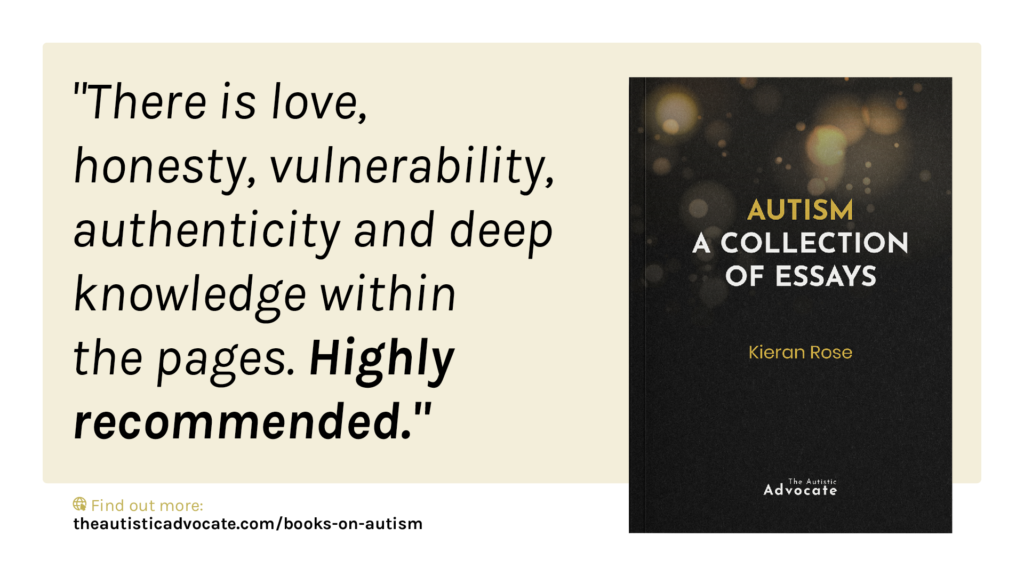
The book gathers seventeen of my most widely read essays written between 2017 and 2025. Taken together, they do much more than just collect some old articles, they collectively trace how conversations around Autistic people have shifted over nearly a decade across society, culture, and academia, while also reflecting the evolution of my own thinking as I have written, learned, challenged and argued, listened, reflected and grown. In that sense, the book becomes a kind of map of the discourse itself: where we started, what needed to change, what has shifted, and what still urgently needs to change if experiences and life outcomes for ALL Autistic people are to genuinely improve.
You can find out more about the book here: ‘Autism: A Collection of Essays’

Across the seventeen essays the book explores many of the themes that have shaped my work over the past decade, including questions about what we mean when we talk about autism, the impact of stigma on Autistic identity and wellbeing, Autistic masking and burnout, the narratives that shape how ALL Autistic people are understood and misunderstood socially and clinically, the gaps between lived Autistic experiences and academic and professional interpretations, and what that all collectively means as we navigate the systems around us.
Some of these essays have been read hundreds of thousands of times online and have been widely shared, discussed in professional spaces, and cited in research. I hope that bringing them together in one place like this allows the broader story they tell to emerge more clearly.
Seeing this book exist feels like an important personal marker in a journey that began almost accidentally. Although I’ve always written, I started publishing essays and articles more formally in 2017, nearly ten years ago now. At the time I had an old Blogger website and writing became a way of dealing with my Dad’s deteriorating health and death, while also trying to make sense of being an Autistic parent raising very young Autistic children, who are now 13, 15 and 16.
I never expected anyone to read what I wrote, or that it would have any kind of impact. I was writing for myself, trying to understand my past, my family, and the family I was now raising.
But people did read it.
And they kept reading.
And they shared it.
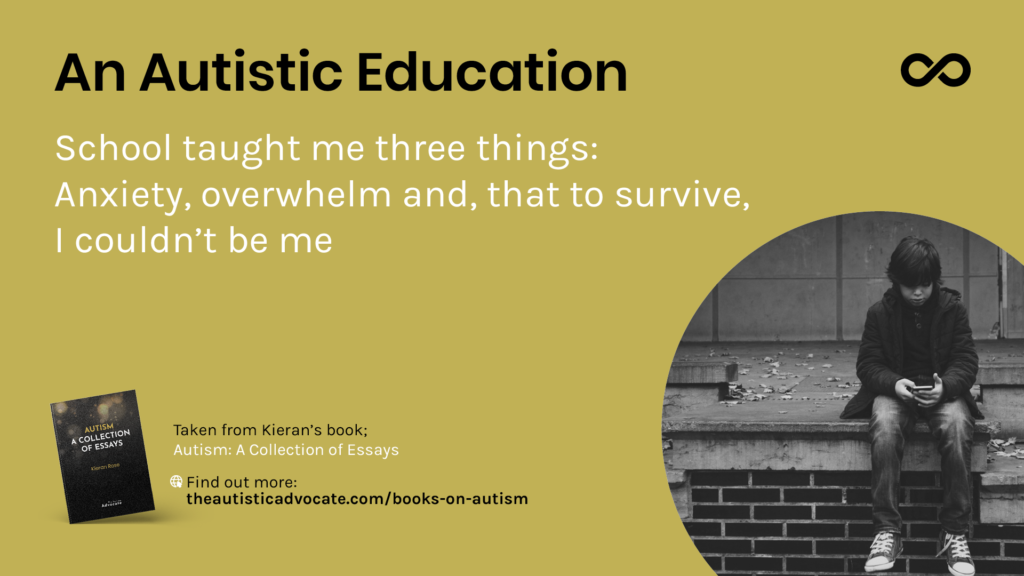
Some of the people who first read my writings back in 2017 are still here now.
Over the years I’ve continued writing. Sometimes the words pour out. Sometimes life becomes difficult and I don’t write for months. Many of you will know that my emails can be quite sporadic.
As with all of my writing, this book is not about me. While some of the earlier essays occasionally include memories from younger versions of myself, or start from a personal perspective or experience, it is definitively not an autobiography. The writing is really about something broader: the collective experiences, narratives, struggles, and strengths of Autistic people.

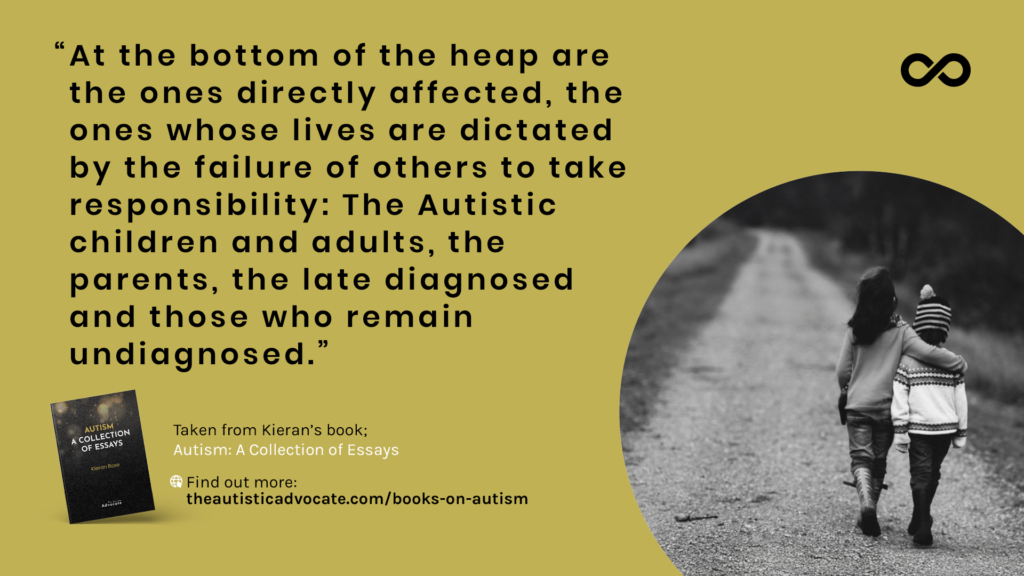
It is not always an easy read. There is humour, love, connection, and recognition in these essays, but there are also difficult truths. There is injustice. There is trauma. And there are moments that call for reflection, both from Autistic people and from those who love, work with, and support us.
The idea for the book wasn’t actually mine. It was Michelle’s, my wife’s, idea.
Michelle suggested that gathering the essays into a single volume could help chart the narratives that have shaped Autistic lives during the years I’ve been writing. My initial reaction was embarrassment: It felt strange to publish a book made up of writing that already existed freely online, and also I look back at my earlier writing and while I see the foundations of where my thinking is now, and the evolution of academic work that strengthens those thoughts, I also look back and see how raw (and sometimes flawed, limited and siloed) those ideas were, and how unrefined my writing was then compared to now. I am not only a better writer now, but I have also changed dramatically as a person in a lot of ways.
I wrote recently in email conversation with someone that: “…people see what I create, but they don’t see what it takes for me to create it…” But Michelle DOES see, and I also see what it takes for her to support me to do this.
So, she persisted, and designed a full chapter as a concept to show me what it could look like. Her idea was simple: people often want something tangible. Something they can read and re-read, something they can return to at different points in their lives, share with others, annotate, underline, and leave covered in post-it notes!
She wanted it to be a book people could live with.
Something that could be read from cover to cover, or picked up and put down, or accessed in different ways and from different starting points.
Something that might offer reflection, recognition, or companionship, in what often feels like a very difficult world for Disabled people right now; something I reflected on specifically in this recent piece: Life Is Hard
There were also some practical considerations for publishing it.
It’s an over 400-page book because I write long-form pieces of writing. And I know that isn’t always accessible to everyone, especially online. Some of that writing is light, some of it necessarily dark, and some of it covers complicated themes; Reading all seventeen essays online in one sitting would probably give anyone serious eye strain.
So, in under the pressure of all these sensible arguments, I did what all good husbands do, and eventually said yes 😆
Although the essays themselves are not new, the book is more than simply a set of pre-existing articles placed between two covers.
I’m incredibly grateful that my close friend and colleague, Dr Amy Pearson, who I co-wrote ‘Autistic Masking: Understanding Identity Management and the Role of Stigma‘ with, has written the foreword.
I’ve written a new introduction and preface, and the essays are grouped into evolving themes along with new commentary that helps frame how the conversations around Autistic people have evolved during this time. Looking back over these essays now, what strikes me most is not just what they say individually, but what they reveal collectively about how the conversation around Autistic people has evolved, and in many ways regressed, also.
I hope this book captures a small part of that story: What needed to change when I began writing. What has changed since. What progress has been made. And what still very desperately needs to change.
This book has been three years in the making, and it’s a real joint effort. I wrote the essays, but Michelle has done the extraordinary work of designing the book, shaping how it looks, and helping bring it into the world.
In many ways it feels like a reflection of our own lives together. Two neurodivergent people building an imperfect life and business, raising children, navigating the chaos of home education and work, and somehow staying the course together for twenty-six years.
Just as our own story has changed over that time, the narratives around Autistic people have also shifted dramatically since I first started writing in 2017.
The book is completely self-published, and it’s genuinely been a collaborative effort between the two of us. One of the great privileges of working alongside my wife, and best friend, is that sometimes we get to create things like this together.
Onto the practical details!
You can buy the book through international Amazon stores and UK readers can also purchase it online through The Great British Bookshop. The UK RRP is £22.99.
We’re also working on non-Amazon international options, wider trade availability, and an e-book version, and we’ll share updates when those are ready.
The book is also available for UK trade ordering via Gardners, so if you’d like to help please do ask your local library or bookshop to stock it.
If you’re interested in interviewing me about the book then please feel free to get in touch. Michelle is managing the promotion almost single handedly, so any help that earns me brownie points will be gratefully received.
All the details, including UK and international Amazon links, are on my website here: ‘Autism: A Collection of Essays’
If you do buy a copy we’d love to see it. Please send photos.
And yes, I know every author says this, but reviews really do help other readers discover books, so if you’re able to leave one it would mean a lot.
Finally, thank you so much for being here, for reading my work over the years, and coming along for the ride with me. Every single person I’ve engaged with, directly or indirectly, positively, neutrally, and negatively, has taught me something, and for that I am immensely grateful. I cannot hold this narrative to account, without being supported and held to account myself.
Kieran, March 2026
Where to buy
The Great British Book Shop (UK readers)
Please note; whilst international (non-UK) customers can order from Tge Great British Book Shop your order will be sent DDU (Dispatch Duty Unpaid), which means that any customs or taxes would be charged at point of delivery (not on ordering). We hope to have non-Amazon, international ordering options available soon.
For other countries search for ‘Kieran Rose – A Collection of Essay’s or the ISBN 9781067649609 or using Amazon’s product code of 1067649603 on your Amazon store.
Keep in touch with Kieran Rose, The Autistic Advocate
If you’ve found this article useful you can support my work by donating any amount from $3 (about the same as a coffee – mine’s a caramel latte please!).
I know not everyone wants, or needs, one of my training courses, but I often find people will read one of my free articles and want to say ‘thank you’. And this is a really easy way to do that. It also supports me to keep being able to create new, free content and keep my older, free content up-to-date. It also allow me to keep my website ad-free!
My Autism FAQs page is a good place to start if you’re new to my work and want to explore more and my book, ‘Autism: A Collection of Essays‘ is a great way to immerse yourself info the narratives surrounding Autistic people.
Thanks for you support – it means the absolute world. Kieran x
Got more questions about Autism?
If reading this article has given you more questions then my Autism FAQs is a great place to point you in the right direct to get answers (and most of where I direct you is to free-to-access resources!).
