Disorder or Condition, labels commonly used to describe autism and Autistic people, but why? And what is the impact of them?
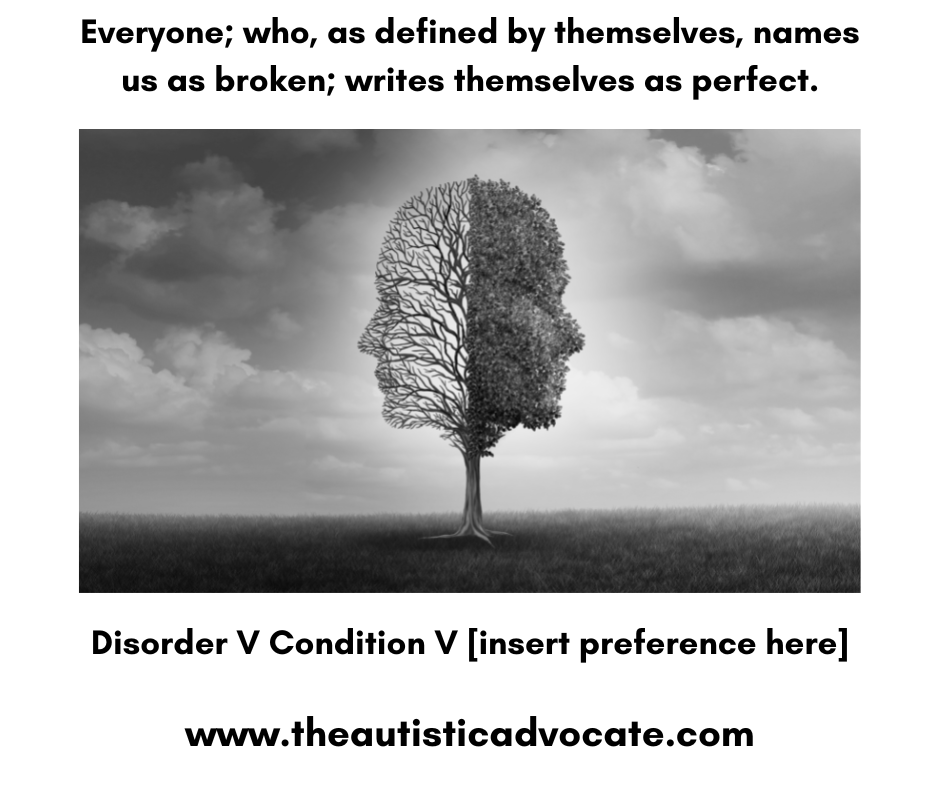
I’ve been seeing a lot of questions recently about the preferences of Autistic people about the terms Autism Spectrum Disorder and Autism Spectrum Condition in relation to autism.
I’ve been wanting to write something on this for a long time, because it’s really been bugging me. Firstly, these binary concepts of one or the other when describing autism, cause my brain to just go ‘Nope’; secondly the idea that one of these terms is better than the other invokes momentous eyerolls in me.
I am always the first person to state that Autistic people should be allowed to identify themselves and autism as they please, ultimately it’s their label, but that always comes with the disclaimer that I truly believed people should be making those choices based on having all the facts and being informed.
So, recently, in a moment of irritation, I wrote a twitter thread for professionals, parents and Autistic people on the subject of Disorder v Condition v [Insert preference here] within the autism narrative, which you can find here.
An expansion on tweets
For those that think ‘Condition’ (as in Autism Spectrum Condition) is somehow a better term than ‘Disorder’ (as in Autism Spectrum Disorder), why don’t you join me as we check out their synonyms in medical terms:
The synonyms for Disorder include:
ailment,
complaint,
complication,
disease,
illness,
infirmity,
malady,
sickness
these are clearly negative and pathologising terms as you’d expect, right?
But what about condition?
Synonyms for ‘condition’ in medicalised terms include:
ailment,
complaint,
complication,
disease,
illness,
infirmity,
malady,
sickness
“Wait, what?!” I hear you cry! “That’s the same as ‘Disorder’!”
If you find that hard to swallow, wait till you find out that again, in medicalised terms, ‘condition’ and ‘disorder’ are synonyms for each other!
The definition of ‘disorder’ in medicalised terms is:
“A disruption of a disease to the normal or regular functions in the body or a part of the body.”
The definition of ‘condition’ in medicalised terms is:
“An abnormal state of health that interferes with the usual activities or feeling of wellbeing.”
‘Condition’ and ‘Disorder’ effectively mean the same thing, they are both part of the same grouping of medical terms that define you as:
ill,
sick,
diseased,
not functioning properly,
not quite right,
broken,
having deficits,
missing bits,
not a complete human being
Stigmatising concepts
Think about what they are saying about you:
that you’re not good enough,
that you’re incomplete,
that everyone else is perfectly formed and you are aren’t
Now don’t get me wrong, lots of Autistic people do actually feel that way about themselves, but why is that?
Is it because we really and truly are incomplete humans?
Or is it because we are pathologised on every aspect of our existence whether we know we’re Autistic or not?
And because we are corrected on every aspect of who we are pretty much from birth because we don’t conform to a normative narrative?
And because we are surrounded by the privilege of people who assume that because a majority of people conform to a certain way of existing, that there is only one right way to exist?
Broken human being, or treated awfully? Which of those is more likely?
Hmmm…
So lets go out on a limb here:
Do many Autistic people consider themselves broken because they are, or because that’s what they are told, that’s how they are identified; by those very same privileged and hubristic people that surround us and control our narratives?
The same privileged and hubristic people that create and control the environments around us and the ideologies that lead us to be excluded, isolated; to struggle physically and mentally, the very things that cause us to think we’re damaged and broken.
Environments & narratives created & maintained by those who are not Autistic, who have created a world centred not on autism and Autistic people, but on non-Autistic needs & non-Autistic conventions.
Force any creature into an environment it cannot inhabit and see if it fails.
The neurotypical world even has sayings for exactly this “A fish out of water!”, “A square peg in a round hole!”
If a creature struggles in an environment that harms is it, does that mean it’s broken? If you take a fish out of water, do you spend a hundred years and billions of dollars trying to find ways to make it breath on land (Don’t answer that because there probably is someone wasting their time doing that!)?
Thinking back to ‘Disorders’ and ‘Conditions’
Whose terms are they?
Who created those narratives?
Who perpetuates them & who controls them?
Is it Autistic people?
Of course not!
Everyone; who, as defined by themselves, names us as broken; writes themselves as perfect.
And bless them, so secure are they in their arrogant perfection, they have even created manuals to define our disorder, our condition, named autism:
The DSM,
the ICD,
within which they monument their perfection, by identifying the ways in which we are incomplete versions of them.
So Disorder or Condition… Which is better?
When we use terminology like this about autism, about ourselves, we need to know what this terminology means and how it impacts us.
How it stigmatises us, how it corrupts us and our self worth.
Understanding that is imperative
When our families use terminology like this about autism, about us, they need to know what that terminology means and how it impacts us.
How it corrupts us and our self worth.
Understanding that is imperative
When Professionals use terminology like this about autism, about us…
Unfortunately they know what it means. It’s literally their language.
They even know the impact of that language, there’s plenty of evidence of that.
Good intentions can go in the bin if you are a professional adhering to terminology that is evidenced to cause stigma.
Understanding that is imperative.
So if you consider that ‘Condition’ is better than ‘Disordered’, do you mind if I ask why?
Or, to take things one step further, how about a novel idea:
You’re neither of those things.
You have neither of those things.
Why do we have to be restricted to binary terms that do nothing but reinforce awful things about Autistic people?
Why do we have to be restricted to pathologising terms that reinforce notions of a linear spectrum from ‘most offensive Autistic’ to ‘least offensive Autistic’? The idea of the spectrum is akin to functioning labels. Things which are literally used to divide us based on ideas around societal value. It’ll never be recognised as a term defining us individually different, no matter the intention within which it was first conceptualised.
How about a third option?
You’re Autistic!
And highly likely a significant number of other things too!
On my training, The Inside of Autism I identify an inexhaustive list of over 70 commonly co-occuring things. Some of those might even be acceptably considered conditions, but none of them are ‘autism’
Now don’t put words in my mouth here, because I consider myself Disabled. I’m disabled by social barriers AND by aspects of who I am that aren’t suited to the world around us.
Does that mean I’m an incomplete, diseased, broken version of a gold-standard perfect human?
No.
Take that arrogance and shove it far and high.
Because it’s Ok to be disabled. Disability is everywhere.
But it’s not ok that social barriers exist.
And the existence of either of those things is not cause to see Autistic people as broken.
ASD, ASC, or neither.
Call yourself what you will, but please make sure you understand the context of what you call yourself. You might not care, but that doesn’t mean that others aren’t stigmatised by things you are justifying by your ambivalence.
Just some food for thought.
If you’ve found this article useful you can support my work by donating any amount from $3 (about the same as a coffee – mine’s a caramel latte please!).
I know not everyone wants, or needs to buy one of my training courses, but I often find people will read one of my free articles and want to say ‘thank you’ (and this is really appreciated as they’re a lot of work to write!) Buying me a virtual coffee is a really easy way to say thanks. It also supports me to keep being able to create new, free content and keep my older, free content up-to-date. It also allows me to keep my website ad-free!
My Autism FAQs page is a good place to start if you’re new to my work and want to explore more. Thanks for your support, Kieran.
JOIN KIERAN’S MAILING LIST (for infrequent, but useful, updates!)
And, as a thank you for joining, you’ll get a 10% off code emailed to you which you can use on Kieran’s on-demand autism training and ebooks (including his flagship training The Inside of Autism).
Training and ebooks from Kieran
I have a full range of autism training and ebooks on my website; starting from just a few dollars and all priced to be affordable.

Got more questions about Autism?
If reading this article has given you more questions then my Autism FAQs is a great place to point you in the right direct to get answers (and most of where I direct you is to free-to-access resources!).

6 replies to "Autism and it’s labels: Disorder and Condition"
Yes absolutely agree.
In Switzerland it is just as bad. It is called Störung. Which translates to DISTURBANCE literally. Or if you check the English dictionary it says: disturbance
disorder
hitch
disruption [of class, meeting]
perturbation
interference
malfunctioningengin.tech.
failure
breakdown
faulttech.
nuisance
bugcomp.
bother
derangement
interruption
noise
annoyance
upset [disturbance]
accident
impairment
compromise..
YIKES.
My neurotypical psychologist and autism expert (she is head of an autism and mentally disordered foundation) insists on calling it that. A disturbance.
It is so frustrating. In Switzerland advocacy is in stone age.
The main association is led by parents for autistic kids and therefore they have very different goals.
Also disability is not quite fitting, because we are disabled by society, the environment, the authorities, who prevent access to higher education by their rigid, moronic ideas of what autistics can and can’t do.
But still the best term in my book….
In Switzerland it is just as bad. It is called Störung. Which translates to DISTURBANCE literally.
Not just in Switzerland, either. In every German-speaking country.
I knew there was a reason that I was so disturbed by the term ‘condition’ in relation to autism that I quit using and started using ‘neurodivergence’ in its place. Thank you for clarifying my feelings for me. 😄
Synonyms for ‘condition’ in medicalised terms include:
list of synonyms for the word ‘disorder’ follows
I knew there was a reason that I, a linguistic savant, felt disturbed and creeped out by the word ‘condition’ when used in that context! Thanks for that.
I often talk about autistic qualities or the autistic profile, I don’t like medicalized language and try to avoid them. I am autistic and my autistic profile is different from other autistic profiles. Labels can be divisive, and people end up either in the in-group or out-group due to the language used. There can be a bi-directional misunderstanding that happens between autistic and non-autistic individuals due to slight differences in communication styles. Rigid social expectations tend to favor non-autistic people.
I never thought of it that way. I think it is a good thing to talk about becuase a lot of terms we use to describe disorders are a lot of the times negitive in the definition. I feel like we need to come up with a less negative tearm the just disorder or condition.