Jodie Clarke is a children’s well-being practioner in Wiltshire, England, who works with Autistic children and families of Autistic children. Often that support sadly comes at a time when Autistic children are struggling in education and relationships between schools and parents have broken down or are breaking down.
Lots of these break downs occur because the Autistic child in the scenario can no longer attend school because of Burnout, or is hitting so many barriers that school is becoming an impossible place to be.
Many education staff are unable to recognise the factors that prevent Autistic children from accessing education and that’s mostly due to a lack of applicable knowledge, confirmation bias, and the veil of professionalism that many professionals feel that they have to maintain where they are the ‘experts’ and acknowledging that they are not is deemed as a weakness or incompetence; Which is not a judgement of education staff at all, it is the reality of the situation from the Autistic perspective that the majority of Education staff along with many professionals from many other fields, have not been enabled with a true understanding of Autism and what it means to be Autistic.
Jodie, in her experience, noticed a common theme in her interactions with schools and similarities with something commonly reported by parents, this notion that the Autistic child has to ‘learn to live in the real world’.
So it really does beg the question, “What world are we preparing them for?”
Let’s see what Jodie thinks:
What world are we preparing for?
Before I start I want to praise and acknowledge all the incredible schools that I work with who work tirelessly to support many of the wonderful children I meet. A positive experience of collaboration, adjustments, validation and inclusion is common place for me nowadays but if we don’t speak out about things that aren’t working for some, we won’t ever make progress to a better place.
I want to talk or (maybe rant) a little about the statement:
“We have to prepare them for the adult world”
Or even better:
“We have to ensure they can manage in the real world”
This is the reasoning I hear time and time again about why a child should be subjected to a noisy corridor in school, or why we shouldn’t always be “allowing them to avoid” the smell of the dinner hall, or the supermarket.
I hear this time and time again when we are simply requesting people to abide by the law and put in place reasonable adjustments!
I hear it when we are discussing school “refusal” (it’s not refusal, the child is unable).
I hear it when I ask if the child can remain next to the safety net of the one friend who provides them with academic and social support; “they have to get used to socialising with other people”!!!
So, for me what this statement suggests is that in order for a child to be a ‘successful’ adult (whatever that looks like, which again is up for debate!) that child has to be desensitised and taught how to mask and supress their distress! I’m sorry, but this screams to me that what this will actually achieve is to cause a child to have massive mental health difficulties.
It may look as though it’s been a success from a non-autistic or outsider’s perspective but trust me, inside the turmoil, the anxiety, the exhaustion, the self-loathing with be gradually killing any positive self-identity. These children WILL NOT become ‘successful’ adults.
Let me give you all a little insight into a successful autistic adult’s lifestyle (just one adult, this isn’t a blanket measure of success for all autistic people):
- Working in a job that is based around a special interest i.e. incredibly motivating and fulfilling.
- Choosing to shop online, or visit a small local shop.
- Eating when is needed and what is safe.
- Choosing to take a lunch break alone.
- Ending up in a role where you are surrounded by other autistic people who get you and you are accepted for who you are and as you are (I suggest reading up on Damien Milton’s Double empathy theory)
- Being allowed to use the loo whenever you like and not having to raise your hand to ask (embarrassingly), or wait until break!
- Choosing to get up and move when someone next to you opens a lunch box with an egg sandwich in!
- Choosing to get up from your workspace whenever you want for a sensory break, or movement break (in fact it is actively encouraged in many workplaces!)
- Choosing to socialise with who you want and as many or few people as you want! (Not necessarily a group of 30 who are all within 6 months of your age, given that when we get to work we are normally surrounded by people of all ages!)
- Choosing to socialise how and when you want (not all day long) and sometimes via a screen.
- Choosing a role that involves being outside or with nature or a role which allows you to work from your home.
- Choosing a role that has a flexi element in terms of time and working from home arrangements.
- Being able to call in sick on mental health grounds and with the backing of a GP without being called a ‘work refuser’.
- Choosing a role which doesn’t involve a uniform that causes immense sensory distress
- Being able to get up and leave a meeting/work space, without being deemed non-compliant.
- Choosing to spend all free time indulging in activities that bring pleasure.
- Feeling free enough to stim when you want.
The list could go on, but my argument here is that how on earth is a mainstream school anything like real life! You could argue the opposite, or even that it’s better stated that it’s preparing a child for an institution! Maybe prison?!
School policies are not real life!
My concern is that by insisting an autistic child complies to these ableist normatives the more risk there is that they will not become a successful autistic adult.
A child needs skills such as self-advocating so they can request adjustments, self-care so they know when they need rest time, self-awareness so they understand their challenges and that those challenges are valid and real, positive self-identity so they can be truly themselves without fear of ridicule.
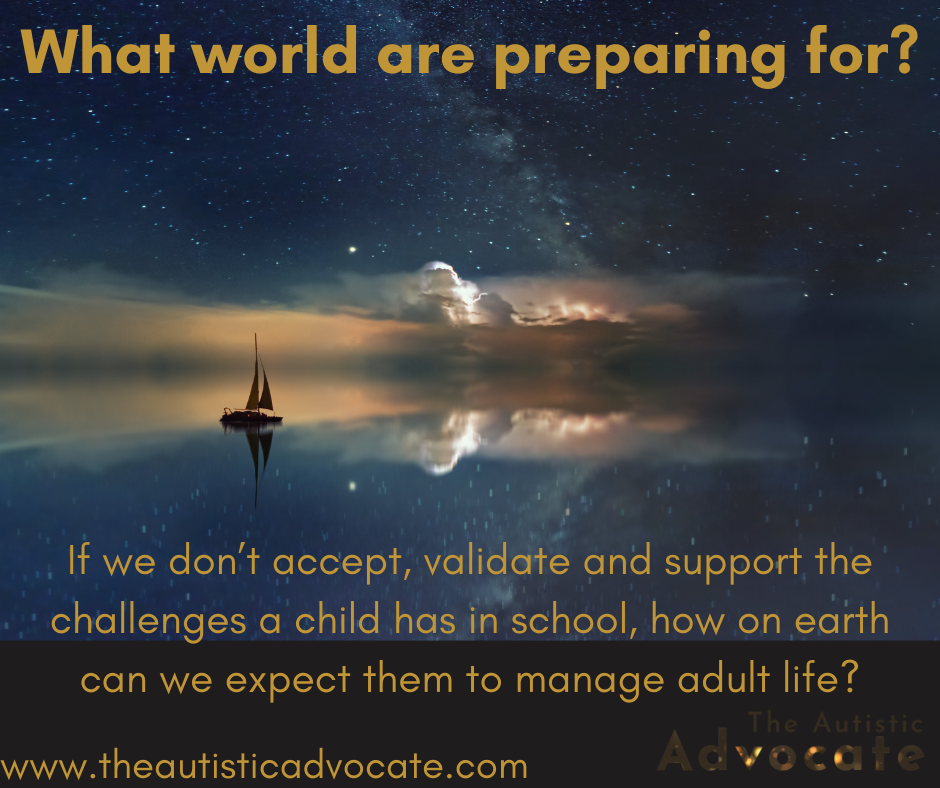
If we don’t accept, validate and support the challenges a child has in school how on earth can we expect them to manage adult life? Have some empathy for the autistic experience.
‘Getting used to it’ (or desensitisation or that awful, awful word; resilience)) does not happen (and there is research to back that up!) A ‘getting used to it’ approach causes trauma. This is compliance therapy in disguise.
The ‘Golden rule’ here is Environment + Autism = Outcome (Dr Luke Beardon)
The environment being deemed ‘mainstream’ is not justification for this treatment, if all teachers are teachers for SEND (‘Special’ Education), then so are all schools places for SEND children.
Stop making autistic children do all the compromising.
Stop traumatising children while making out you are helping them!
Some additional thoughts from Kieran:
I think for me this piece raises another question, phrased similarly, but reflecting on a pertinent aspect of the problem:
‘Whose world are we preparing them for…?‘
When people talk about Autistic children needing to enter the ‘real world’ what they are really referring to is the non-Autistic perception of the world. They’re saying;
“We want you to be like us…”
“You have to be like us…”
“You need to bend until you fit in with us or you break…”
All of this is wrapped up in privilege and ableism. First there is the assumption that to be non-Autistic is a gold-standard way of being and to not be like that, or not want to be like that, means you are incompretent and a not fully formed (or broken) version of a human; a pale imitation…
Second, is the notion that prevails in the non-Autistic mind that to be non-Autistic is the only way of existing; and that anyone who doesn’t meet that standard is not going to be fulfilled or be able to live a life worth living.
Very few people actively think that, or at least would admit to it (some definitely would and do) but that we are not fully human is the underlying unconscious thought that has run through the collective conscious of society regarding Autistic people for a very long time.
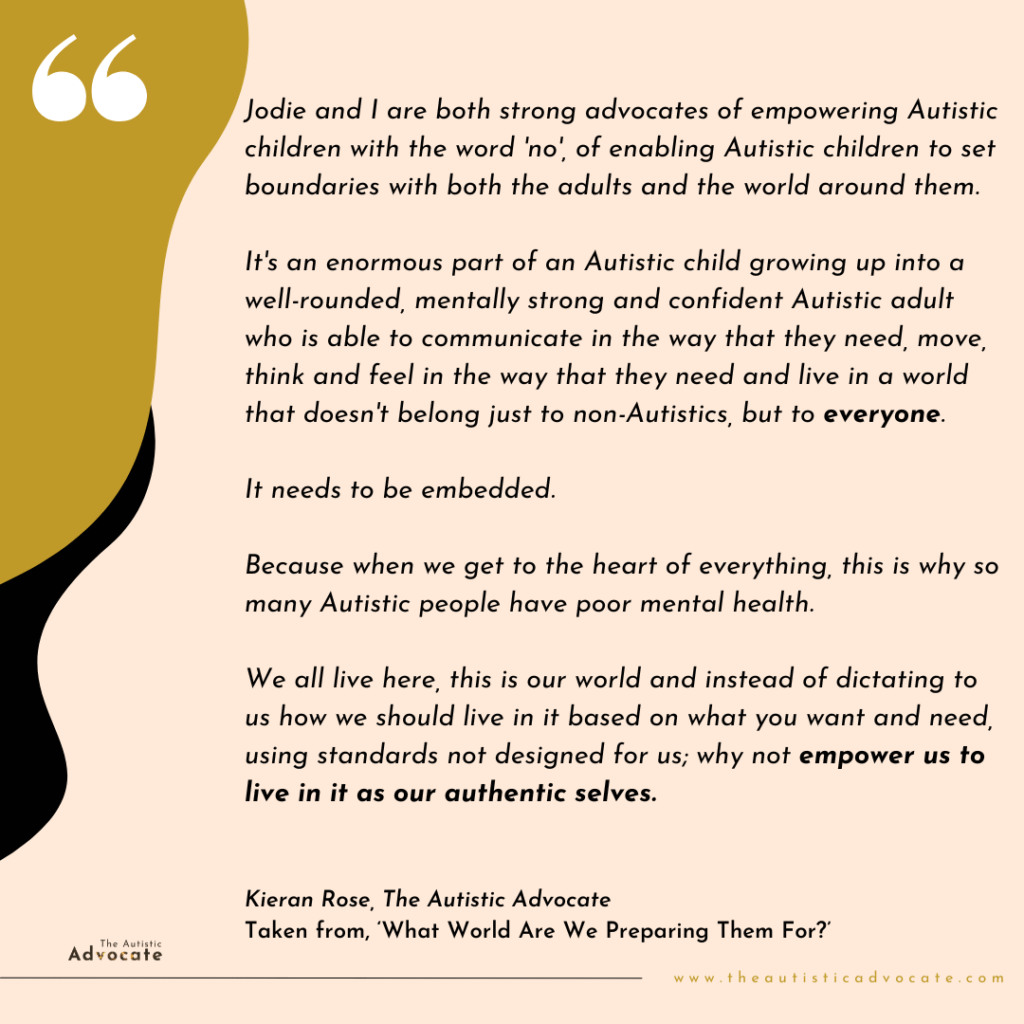
Jodie and I are both strong advocates of empowering Autistic children with the word ‘no’, of enabling Autistic children to set boundaries with both the adults and the world around them. It’s an enormous part of an Autistic child growing up into a well-rounded, mentally strong and confident Autistic adult who is able to communicate in the way that they need, move, think and feel in the way that they need and live in a world that doesn’t belong just to non-Autistics, but to everyone.
It needs to be embedded.
Because when we get to the heart of everything, this is why so many Autistic people have poor mental health.
We all live here, this is our world and instead of dictating to us how we should live in it based on what you want and need, using standards not designed for us; why not empower us to live in it as our authentic selves.
What’s stopping you?
2025 Update
I shared this article to Facebook and was going to only write a brief post to go with the link. But it ended up becoming something more. So I have added my extra thoughts here to the end of the original article for completeness.
How many times, as a parent of an autistic child, have you been told by schools or other professionals:
“We have to prepare them for the adult world” or “We have to ensure they can manage in the real world”
Whose world exactly are they wanting your child prepared for…?
Have no doubt, they mean a world full of stigma and privilege.
A world full of capitalist ideals where your worth and value is measured by your productivity.
A world where your child will never be supported to access their Autistic identity in a meaningful way, or conversely will be stripped of their Autistic identity, forced to project acceptability and mask for safety; leading to the fracturing of their identity, will have their mental health shaped around the needs of others and will be given the idea that they are not good enough, they’ll never be good enough, unless they pretend, pretend, pretend.
Because again, have no doubt; your worth in this world of stigma and privilege is linked entirely to your productive output (be that the GCSEs you achieve or the salary you get taxed on).
This world wants, no expects, Autistic people to bend and bend and bend to meet neuro-normative expectations, to grease the wheel of society, to make things easy, and by doing so disappear anyway.
And when the autistic person finally breaks: does the world support them and recognise its culpability? Of course not, it victimises, it excuses, it rejects the notion of any responsibility; the world got its productive pound of flesh, so it cares nothing for you now. It always saw you as broken, as expendable, as less than, so it cares not that you broke yourself in service to it. All this just proves you are not worth enough.
Is THIS the world you want your children prepared for?
It’s not the world I want my children to grow up in. But with welfare reforms looming, inaccurate claims of ‘explosions’ in autism and ADHD diagnosis, talk of parents of neurodivergent children ‘gaming the system’, and unnuanced and uncontextualised takes that our autistic children are despairing at their identity, actively rejecting it at every turn; along with so much truly disturbing rhetoric around DEI everywhere right now, that does not recognise the role that stigma and expectation and demand plays; this is the reality of the world that exists.
But is it?
There is a different path that can be forged… An extraction from systems in ways you can do safely if you hold the privilege, a curiosity and exploration of what a world looks like when your family acts as a unit, a team; a protective line which can be drawn around aspects of your family which are not solely about being protective but is also there to hold space for you while you curate agency. A recognition that what the world demands on the surface, the messages that schools and governments reinforce about the steps you must take to live your life, are just demands, and that life can be lived in many ways, non-linearly.
Because when autistic people have more context for their experiences, more self-understanding of their identity, more agency in decisions which impact them, more autonomy over their own lives, and a greater ability to live authentically, these all have positive impacts on their life outcomes and the wider world. When you are not mired in stress and a lack of choice, options can and do open up. It can take privilege and drastic change and time, but agency can be had.
Our autistic children are not in despair because they are Autistic, or because someone has said they are; if they are in despair, it’s because this world has attached so much stigma and shame to this beautiful identity of theirs that has been prevented from flourishing, been fractured, warped and mis-shaped. It’s because the shame and stigma that parents carry, communities carry, that even the most knowledgeable professionals carry, is inadvertently passed down to our children.
It warps their sense of self, so they stigmatise themselves, they don’t want to be different, because the ‘real world’ has told them subliminally that to be different is to be wrong.
That you are a non-conformist.
Trouble.
Someone to be singled out.
Someone to be mocked.
Someone to be rejected and punished.
We cause harm through good intention; we cause harm through fear of risk; we cause harm through inaction.
We cause harm when we aren’t critical. When we don’t reflect. When we don’t learn.
We cannot and shouldn’t force our children to adopt identities that they are not ready for, or might reject outright. But we can aim to curate safety by providing islands of safety, to extract and protect from and mitigate harm where we can; and while doing so we can slowly work on being present, on joy, passion, self-esteem, self-worth, and empowerment. Existing in a way which is meaningful. Discovering our value.
This is not a superhero narrative, this is the promotion of an honest, validating narrative of the impact of a very real and painful world that can exist and does exist, but exists alongside a world where you can curate the life you would like to lead. It may not be perfect, it may still be problematic in some ways, but it’s a world that you have applied agency to and have some ownership over, not just passively accepting that life is shit and then you die.
If we want a world that values all of us, it starts here, with rejecting the idea that Autistic people must bend and break themselves to fit someone else’s mould. With the rejection that life is what the ‘real world’ decides it is, and we all must conform to that without question. With the identification and rejection of stigma. With the recognition that the value that you, and that our children have, is inherent within you.
‘Real world’, here is our boundary:
No, not today.
If you’ve found this article useful you can support my work by donating any amount from $3 (about the same as a coffee – mine’s a caramel latte please!). And please don’t forget to visit Jodie’s website where you can sign up to her mailing list, read her work and discover her great books.
I know not everyone wants, or needs, one of my training courses, but I often find people will read one of my free articles and want to say ‘thank you’. And this is a really easy way to do that. It also supports me to keep being able to create new, free content and keep my older, free content up-to-date. It also allow me to keep my website ad-freel My Autism FAQs page is a good place to start if you’re new to my work and want to explore more.
Thanks for you support – it means the absolute world. Kieran x
Further reading from Kieran about education
School Refusal or School-Induced Trauma? Rethinking EBSA, EBSNA, and the harm we call help
Autistic Masking: The Basics and Beyond: A training session delivered by Jodie and Kieran
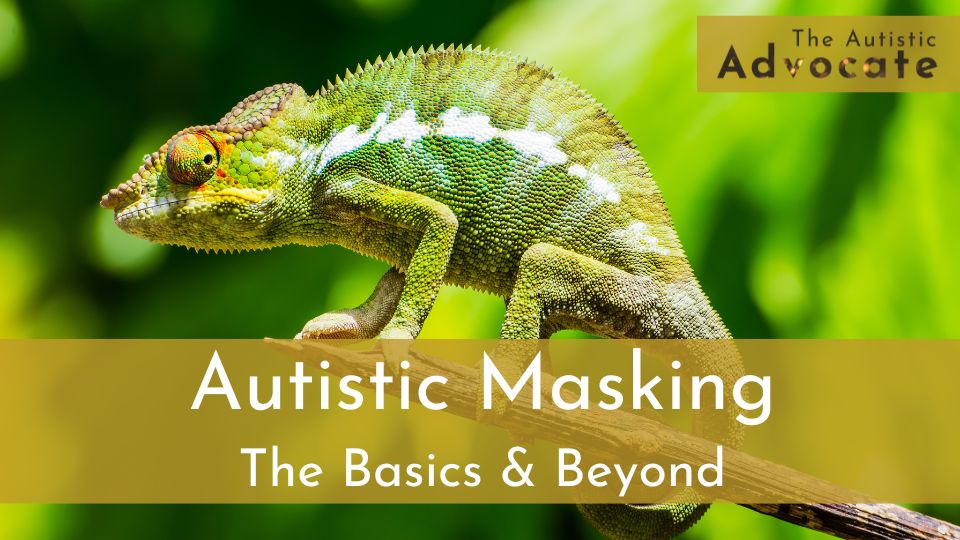
Kieran and Jodie invite you to explore all things Autistic Masking. This is a one-off training session delivered by Jodie Clarke (previously Smitten) and Kieran Rose. It was originally recorded live. It is a great introduction to the concept of Autistic Masking.
Incorporating training, discussion and Q&A, this training is focussed towards autistic children and education.
This now a ‘golden-oldie’ of a training, as it was recorded in 2021, but with nearly 800 students worldwide it continues to really popular and is a great introduction into Autistic Masking in children.
Find out more and buy the training here Autistic Masking: The Basics and Beyond. The training costs $15/£12/€13,50.
JOIN KIERAN’S MAILING LIST (for infrequent, but useful, updates!)
And, as a thank you for joining, you’ll get a 10% off code emailed to you which you can use on Kieran’s on-demand autism training and ebooks (and can be used on the Autistic Masking training).
You might also be interested in my online, on-demand autism training
I have a full range of autism affirming, on-demand training available on my website: Browse Online Autism Training

If reading this article has given you more questions then my Autism FAQs is a great place to point you in the right direct to get answers (and most of where I direct you is to free-to-access resources!).

4 replies to "What world are we preparing them for?"
I have never read anything as enlightening as this . I wish I was elequent enough to explain how evoking this post was. I am greatful to know that research is and will continue into childrens different needs to help them become comfortable and confident in their choices throughout their lives. My heartfelt respect and love goes out to the strong caring patient individuals who are 24/7 involved in a hands on persuit to these ends. from a loving Mum of six children who are all valliently coping with an ever unprepared world.
Thank you 🙏
Thank you!
Mum of 12 year old son here.
I need guys like you to validate my beliefs (which are as yours-truths actually) . Because no matter how strong that belief, when up against it every day , backed into a corner, you have a wobble.
Thank you for reminding me . Thank you for all you do.❤️
[…] Smitten, J. (2020). What world are we preparing for? The Autistic Advocate. Recuperado de (https://theautisticadvocate.com/2020/11/what-world-are-we-preparing-for/). Traducido Por Maximiliano […]