We rarely ask why we eat the way we do.
We’re taught that food is about nutrition, about health, about fuel. That it’s about discipline and balance, variety, and moderation. That it’s about trying new things, sitting together, sharing a meal. That a “good eater” is someone who is not too picky, not too repetitive, not too emotional, not too extreme. And if someone resists these ideas, if they eat the same foods every day, or avoid entire textures, or refuse to eat in front of others, we label them difficult, disordered, or dysfunctional.
But who decided what eating should look like? Who gets to define what is healthy, what is normal, what is enough?
For many Autistic people, food is not just food but a site of survival, of regulation, and of resistance. A language, and a trauma. Food can be fiercely controlled because so much else is not. Or it can be something abandoned entirely because it has always been a source of fear, shame, or overwhelm.
Food is rarely just about what is on the plate. It’s about everything that has been projected onto the act of eating: from childhood expectations to cultural values, from medical narratives to therapeutic goals. It’s about the performance required to be seen as acceptable, about the gaze. Food becomes one of many places where identity is negotiated, sometimes suppressed, and sometimes completely denied.
***
And because of all this, a warning for what is ahead. This article explores Autistic food identity and the common reality of an Autistic person’s relationship to trauma, stigma, invalidation and shame.
This might be triggering for any Autistic person reading this, but specifically those with food trauma, poor body image and those who may have experienced various forms of eating disorders. Please read on with caution.
For Professionals and caregivers this article may raise all sorts of questions about belief systems and practice, and also reflection on your behaviours, which might invoke your own feelings of guilt and shame. Please remember this article is not about punishment or finger pointing, but an honest exploration of what all this means for the person at the heart of it. Consider it an opportunity to reflect and move forward constructively and with empathy.
Lastly, this article is LONG. I have provided regular pause points all the way through, with questions to reflect upon whether you are Autistic, a caregiver, a professional, or a mix.
***
When we do talk about Autistic identity, we often focus on obvious things like communication, cognition, behaviour. But Autistic food identity is just as deeply embedded. Just as shaped by sensory worlds, by safety needs, by routine and ritual, by interoception and trauma, by cultural story and personal meaning.
Autistic food identity is the emergent narrative of how a person’s body, culture, neurology, and relational experiences shape their relationship with food, and by extent of how identity works, becomes part of the broader narrative of how an Autistic person exists within the world. For some Autistic people, along with sensory experiences and communication, our relationship with food and eating is one of the first aspects of identity to be pathologised, and one of the last to be recognised as valid.
Identity is not built in a vacuum. It’s shaped by power, by whose needs are accommodated and whose are dismissed, by whose discomfort is centred and whose is ignored, and in relation to food, by whose food habits are respected as culture and whose are framed as dysfunction.
This shaping begins early, often before a person has the language to describe their experience, and it’s reinforced constantly through different mediums such as well-meaning advice, interventions, through pressure to “just try a bite.”; through side glances at restaurants, through reports that describe “food issues,”; through labels that reduce autonomy to pathology.
This shaping doesn’t just happen by accident but is part of a broader pattern of control that targets Autistic bodies, needs, and expressions across all domains of life. It’s a form of ‘Neurological Imperialism’: the systemic imposition of neuro-normative values that dictate how Neurodivergent people are expected to think, move, speak, relate, and in this case, eat.
Pause Here And Ask:
Have you, or someone you care about, ever been described as being a ‘fussy’ or ‘rigid’ eater?
What impact might that might have had on you/them? How might that have affected your/their relationship with food?
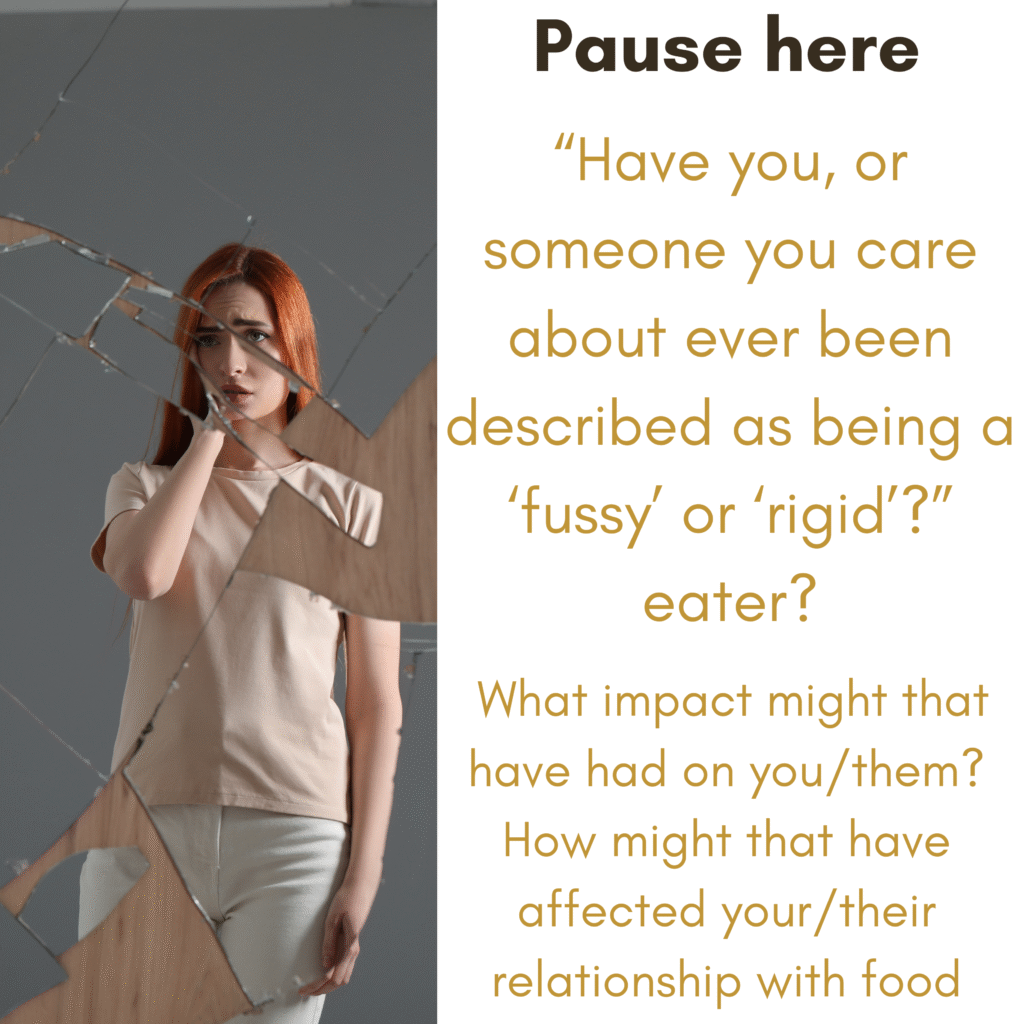
When Autistic food preferences are scrutinised, medicalised, or erased, it isn’t support. It’s colonisation.
Normative expectations around food are not just preferences, they are ideological. They tell us what we should eat, how we should eat, when we should eat, where we should eat, and who we should eat with. They centre dominant cultural ideals: variety as virtue, sociability as health, compliance as progress. These expectations are not universal. They are rooted in Western, individualistic, ableist, and often colonial assumptions about the body, about family, about health, and about what counts as “good behaviour.” They erase the nuance of food rituals, the reality of sensory needs, the legitimacy of avoidance, and the complexity of culture. They reward conformity and penalise difference.
The dinner table becomes another border where compliance is demanded in exchange for inclusion and where food becomes not just sustenance, but evidence of acceptability.
For many Autistic people, the act of eating is only possible when there is predictability, familiarity, and control. Safety isn’t built through eye contact and shared tables, it’s built through consent, trusted textures, through food that doesn’t change, and through environments that don’t demand endurance. For those who experience the world through heightened sensory input, shifting internal signals, and chronic external scrutiny, felt safety is rare. And without it, food can quickly become a site of overwhelm, rather than nourishment.
These dynamics don’t impact all Autistic people in the same way. Culture, race, class, gender, language, and body shape all shape how food behaviours are interpreted and sanctioned. A white Autistic child who eats only pasta may be called quirky. A racialised Autistic child who does the same may be described as oppositional or neglected. The same act is read through different lenses, shaped by bias, stigma, and power. So on that basis food identity does not exist in isolation, it’s also entangled in the wider matrix of how bodies are controlled, perceived, and permitted to exist.
So we have to ask:
– What if your refusal to eat wasn’t refusal at all?
– What if your insistence on sameness wasn’t rigidity, but regulation?
– What if food wasn’t just a meal, but a mirror of what’s been taken from you?
This article isn’t about nutrition.
It isn’t about vitamins or calories or mealtime strategies, it’s about something much deeper: how food becomes a battleground for identity, how Autistic people learn to contort our brains and bodies in order to appear acceptable, how masking starts within the body, and how the rituals around food are often the first to be broken by other people’s expectations.
It’s about control. Communication. Autonomy. Trauma.
It’s about safety.
And reclamation.
Because when someone says: “I can’t eat that,” or “I only eat this,” or “I need to eat alone,” what they are really saying is, ‘This is how I survive. This is how I protect myself. This is how I know who I am.‘
Pause Here and Ask:
What rules were you taught about how to eat?
Think about things like finishing your plate, trying everything at once, or sitting still at the table? Where did these rules come from?
Food identity is not a concept most people grow up with because we are taught to believe that food is a matter of taste, of tradition, of appetite.
Superficial thinking exists which says that how we eat is simply how we were raised, or how we choose to be. But food identity is more than habit or heritage. It’s not just about what we like or dislike. It’s an embodied, relational construct. A deep and often unspoken negotiation between our neurology, our culture, our families, our sensory systems, our histories, and the stories others have told about us.
It’s shaped by which foods feel safe, by which ones feel overwhelming, by which ones were forced upon us, or withheld. It’s shaped by repetition, comfort, familiarity and by shame. By joy, by rituals we created ourselves, and by those imposed on us before we had the language to say no.
And it’s deeply shaped by whether the body was a place of agency, or a site of control.
For Autistic people, this shaping often begins in silence. In sideways glances. In whispered comparisons to other children. In mealtimes that feel like performance reviews. In worry, doubt, fear.
Pause Here and Ask:
What were you taught makes someone a ‘good eater’?
Where did that idea come from? What did it ask you ignore?
Food identity, like so many other aspects of Autistic identity, is often fractured before it’s even allowed to form.
Food identity does not stand alone but is entangled with all the other pieces of Autistic identity that so often go unrecognised or are reduced to pathology. So in the same way those other domains are impacted, food identity is often fractured by scrutiny, by micro-aggression, by ridicule, by pathologising reports, by behaviour charts, by the slow, steady implication that our relationship with food is wrong. That we are wrong.
Food identity connects directly to communication identity: how we express ourselves, how we say no, how we ask for space without using words. For those of us who are non-speaking, semi-speaking, or communicate through movement, refusal, or ritual, food becomes a primary language.
It’s connected to our sensory identity: the unique ways the body receives and responds to information.
To our monotropic identity: the tendency to focus deeply and intensely on certain experiences, including safe and same-foods, trusted rituals, and the emotional consistency they bring.
To every facet of what makes us who we are as unique human beings.
So when we talk about food identity, we are talking about the nervous system, the biological system, the cultural system, and the survival system. All at once. Our whole personhoods.
And yet so much of our experience is not recognised through a lens of identity, rather a lens of condition, disorder, brokenness. We are collectively and individually dehumanised in almost every facet of life, through every facet of our existence.
Pause Here and Ask:
What is your first memory of food?
Whose voice do you hear?
What did they teach you about your body?
Safety in predictability is not a failure to develop flexibility; it’s a foundation for survival.
Sameness is rarely read through the concept of safety or survival.
When Autistic people eat the same foods every day, the default assumption is that this is a rigid, innate trait of a ‘condition.’ But sameness is often something else entirely. It can be the only available form of control in an otherwise unpredictable life. It can be a response to chronic coercion, sensory assault, or sudden environmental shifts. It can be a strategy for emotional regulation in a world that demands too much, too fast, in too many directions. It can be the clearest expression of felt safety available to someone whose trust in food has been broken.
In many cases, the need for predictability in food is not about food at all. It’s about everything else that was never predictable, about the constant shifting of social rules, the unspoken expectations, the scrutiny of being watched and interpreted. In that context, a single food, prepared the same way, in a trusted place, becomes more than sustenance. It becomes a lifeline.
A tether to the self.
But that need is rarely honoured. Instead, many Autistic people learn early that our food preferences are a problem to be corrected. That liking the same thing too much is childish. That avoiding certain foods is dramatic. That asking for predictability is being difficult. And so we learn to eat in ways that don’t feel right. We learn to smile while we do it. We learn to perform.
We learn to project acceptability.
Food is one of the first places where this begins. One of the first places where masking develops.
When someone swallows a bite that triggers their gag reflex to avoid being told off, that is not resilience. That is a child learning that discomfort is preferable to rejection. When someone eats a socially acceptable meal to avoid judgment, even though it causes shutdown or overwhelm, that is not progress, it’s survival. Projecting acceptability means contorting the body into something others expect and can tolerate. It means providing predictability for others, to keep them safe: performing appetite, suppressing preference, and learning to smile through internal disconnection. And when it’s repeated enough, that disconnection becomes a habit of being.
Pause Here and Ask:
Have you ever eaten the same food consistently by choice?
What does that sameness give you? Comfort? Predictability? Safety?
Food identity does not become more coherent through compliance. It becomes further splintered. The more we are told to eat in ways that betray our bodies, the less those bodies feel like ours.
As with persistent emotional invalidation, through our relationship with food and eating and the outside forces that influence it, we begin to distrust the signals our bodies and brains send. We begin to hide the patterns that help us feel safe. Our hunger, our fullness, our needs become shaped around the need for safety, for agency, the need to survive.
We learn that to be praised, we must be acceptable.
And yet, this same behaviour: repetition, restriction, ritual; is not pathologised in everyone. When a non-Autistic child insists on their grandmother’s recipe every Tuesday, it’s called a family tradition. When a child from a non-dominant culture eats only familiar foods from home, it’s respected as cultural heritage.
But when an Autistic child eats the same safe foods daily, or avoids certain textures, or uses food refusal to maintain safety, it’s rarely recognised as or called culture. Rarely called identity, more commonly called a problem.
So the question must be asked: who gets to have a food identity?
Or at least a more authentic one, not warped by stigma, or a lack of agency in every area of life?
– Whose preferences are honoured as culture, and whose are seen as dysfunction?
– Whose eating patterns are protected as heritage, and whose are flagged for intervention?
– Who is seen as regulating, and who is seen as refusing?
Food identity does not just reflect the body’s relationship to nourishment. It also reflects the body’s relationship to power. It tells a story about what was allowed, what was ridiculed, what was celebrated, and what was controlled; and asks us to consider how deeply those stories are layered in Autistic experience, not only in the systems around us, but also in the systems we have come to internalise.
Because it’s one thing to eat differently, it’s another to be told, again and again, that your difference is disorder.
Pause Here and Ask:
Have you ever said ‘no’ to food and been told off?
What happened next? What message did that send you about your autonomy?
If food identity reflects the body’s relationship to power, then the dinner table is one of its earliest theatres of control.
The dinner table is where many of us first learned what is acceptable, and what is not. Where food became not just nourishment, but performance. Where sameness was met with suspicion, silence with punishment, avoidance with correction. And where praise was reserved for those who complied: who chewed with a smile, who cleared their plate, who tried something new “just to be polite.”
But polite to whom?
Who defines what eating should look like? What counts as good manners? What counts as health?
Across much of the Global North, eating is taught as a moralised act. “Good” eating is framed through a narrow lens of expectations: variety, social engagement, sensory flexibility, adventurousness, punctuality, posture, and politeness.
Children are told to make eye contact at the table.
To eat at the same time as others.
To try everything once.
To stay seated.
To eat what’s made for them.
To be grateful.
To behave.
And when we don’t, or can’t, these norms are enforced, often without question.
But these ideals aren’t universal truths. They are the product of a particular cultural narrative: one that is white, Western, middle-class, Christian, and neurotypical. These values have been exported globally through colonial influence, reinforced through media and health systems, and naturalised through repetition. The result is not just a narrow ideal of how and what to eat, wrapped up in manners, but a system that punishes those who diverge from it.
This is neurological imperialism in action.
When Autistic people are told that our safe foods are “too repetitive,” that our avoidance is “just behaviour,” that our silence means rudeness, that our rituals are “weird,” that is not support. That is colonisation: the quiet conditioning of the body to conform to a dominant neurotype. A demand that Autistic people curate our appetites in service of someone else’s comfort.
Pause Here and Ask:
Have you ever described someone’s eating as ‘fussy’ or ‘rigid’?
What might you have missed? What else could have been going on? What might have been the impact of that?
Under Neurological Imperialism, sameness is not understood as regulation or seeking safety, it’s framed as rigidity.
Food rituals are not seen as meaningful they are labelled dysfunctional. Predictability is not viewed as protective, instead pathologised as obsessive.
Autistic people are not allowed to define our own food values. We are expected to adopt those of the dominant culture. And when we resist, that resistance is labelled defiance. Or dysfunction, illness or disorder.
This erasure is often quiet. It happens through assumptions. Through default meal structures. Through the language of concern. It happens when a parent is told their child’s “fixation” on certain foods needs to be challenged. When a teacher removes safe snacks from a classroom to promote “healthy eating.” When an adult is praised for “expanding their food repertoire” despite the emotional and sensory cost.
It happens when compliance is interpreted as growth, and refusal is interpreted as immaturity.
But this narrative doesn’t land equally.
For Autistic people who are also racialised, or multiply marginalised, the pressure to comply is even greater, and the consequences of refusal more severe. A racialised Autistic child who avoids unfamiliar food may not be offered understanding, but instead face accusations of rudeness, noncompliance, or poor parenting at home. A non-speaking Autistic adult may be force-fed in institutional settings, their refusal dismissed as incompetence.
Autistic food rituals that intersect with global cultural traditions are often erased, misread, or mocked. Under neurological imperialism, even culture itself becomes suspect if it does not fit the dominant frame.
And that frame is upheld by surveillance. School lunchrooms, extended family dinners, shared meals at clinics or therapy centres, all spaces where eating becomes public, observable, open to judgement.
Autistic people learn early that every bite may be watched. Every hesitation may be noted. Every preference may be pathologised. Every routine critiqued. To eat differently, or to eat different things in public, is to risk scrutiny, to being seen as difficult. To not eat at all is to risk being punished or excluded.
Under the gaze, food becomes a risk, not a right.
And when that gaze is internalised, the damage multiplies. The body becomes more of something to distrust, to outmanoeuvre: Hunger is suppressed. Disgust is hidden. Expression is neutralised. Autistic people learn to perform safety, even when safety is absent. We learn to swallow distress with each bite. To dissociate from the act of eating. To calculate how much we can endure before shutdown comes.
Pause Here and Ask:
Can you remember a time a familiar food suddenly felt ‘wrong’?
What changed? Was it the taste, the environment or something in your body?
Sometimes the only thing an Autistic person can control is what they put in their mouth.
So much of what developing Autistic children experience growing up is (often well-meaning) control by others, and a complete lack of agency. Intentional or unintentional, the impact of that is to exist as though you are occupied by an external force, every aspect of your being monitored, corrected, rejected, and subject to control. Everywhere you go subject to the same pressures. The extent of that solely dependent on if, or where you find recognition or safety, if you ever do.
When that control is threatened by force, by shame, by pressure to “try just one more thing,”, it’s the act of being made unsafe, visible, and palatable.
And this isn’t new.
For many, these messages began long before the language of autism or neurodivergence entered the room. They began with inherited food scripts, unquestioned beliefs about what eating should look like, passed from one generation to the next:
“You don’t leave the table until your plate is clean.”
“You eat what you’re given.”
“No dessert unless you finish your vegetables.”
“Picky eaters are just spoiled.”
These scripts may seem harmless, even nostalgic, but they teach children that their bodies don’t belong to them. That control is love. That full means finished, that hunger is negotiable, and that pleasure is earned.
And these scripts don’t simply disappear with adulthood.
Many Autistic people unfortunately carry them forward, not realising how deeply they were ingrained. They show up again when we judge ourselves for craving sameness. When we apologise for eating alone. When we try to force ourselves into unfamiliar textures to avoid shame. Some become parents, teachers, or clinicians, repeating what they were taught, correcting food habits, enforcing norms in others without realising that coercion shaped their own, unconsciously generating and passing down generational trauma.
Survival masquerading as tradition in a body trying to belong. And who narrates that tradition?
Pause Here and Ask:
When someone refused food, what’s the first thing you assume?
Is it preference, control, defiance, fear or something else entirely?
Language itself often reveals where the power lies.
Words like “fussy,” “picky,” “rigid,” or “disordered” are not impartial descriptors but tools of control, marking one person’s reality as truth, and another’s as deviance.
When professionals write reports that say: “limited food repertoire,” they are not documenting preference, they are measuring compliance.
When parents say: “they’ll only eat beige foods,” they are often echoing scripts handed down to them, rather than describing the child’s full sensory world, or an understanding that this sameness comes from a place of grasping for predictable structure when so much around us is unsafe.
Vocabulary becomes a mechanism of epistemic injustice, stripping meaning from behaviour and replacing it with judgement, intentionally or unintentionally, the felt impact is the same.
The deeper message is clear: nourishment is only valid if it conforms.
Healing is only recognised when it looks like progress, and progress is only celebrated when it mimics the neurotypical template. An Autistic person who learns to suppress food rituals is praised for “improvement,” even if they are now eating with nausea, shutdowns, or disconnection. But this is not healing, it’s hiding. Its performance rewarded with approval. The performance of wellness often indistinguishable from the performance of masking.
And food is often the first rehearsal. A child learns that eating what’s expected is more important than saying no. That liking the ‘right’ foods is safer than listening to their body. That being acceptable is worth more than being well. And that their worth is measured not by how they feel, but by how well they can disappear the parts of themselves others find uncomfortable. It’s indoctrination.
Who taught you how to eat? Who did they learn it from?
The answers are shaped by time, place, class, and politics. In many cases, they were shaped by scarcity, by war, rationing, poverty, by survival. But when those same cultural norms are carried forward without reflection, they become tools of conformity rather than care. And for Autistic people, who already live under constant pressure to adapt, those tools can do lasting harm.
Food norms don’t just control what we eat, they control how we see ourselves.
A child whose needs are always questioned learns to question them too.
A child who is shamed for preferring the same foods learns to associate consistency with failure.
A child who is praised only when eating “normally” learns to hide the truth of what feels safe.
Over time, these small erasures add up, and the internalisation of food norms becomes part of the broader internalisation of stigma. And what began as nourishment becomes another act of negotiation. Another mask to wear.
And yet, even in this landscape of control, some acts remain sacred…
The quiet refusal.
The hidden snack.
The food smuggled into a pocket.
The ritual that is never explained.
Tiny acts of resistance, however they look. They are the body’s way of saying: I will not disappear. Not entirely.
Pause Here and Ask:
Were you ever praised for eating something that didn’t feel okay?
What happened when you shared that preference? Was it respected, dismissed or made into a joke?
The dinner table, like so many other spaces, becomes a colonised space. A place where the body is governed. Where rituals are corrected. Where expression is silenced. And where identity is shaped not through affirmation, but through endurance.
For many of us, Masking develops in the highchair.
It’s fuelled by the bite we are told to take, even though it turns our stomach. With the praise we receive for “trying,” even when trying means disconnection. With the pressure to sit still, make conversation, smile while chewing, tolerate the clink of cutlery, the texture of overcooked vegetables, the sting of fizzy drinks. The expectation to clear your plate. To be grateful for what you have. It begins when the language of politeness is layered over our distress, when performance becomes more valued than presence. And it begins when we realise that survival requires us to project a version of ourselves that others will accept, even if it’s nothing like who we actually are.
We don’t mask to hide; we mask to be safe, to be manageable. We mask by making ourselves appear in exactly the ways others expect us to be based on their perception of us: the quiet one, the boisterous one, the clown, the big behaviour.
Masking is often misunderstood as just quietness, compliance, or camouflage. But that is only one face of it. It’s not always smallness or stillness. Some of us mask through movement, noise, contradiction, humour, boldness. We learn to project confidence, chaos, cleverness, charm. We become the class clown, the overachiever, the problem child, the one who always makes a joke before someone else can say something cruel. We create a version of ourselves that is predictable to others, our identities moulded by other’s perceptions of us – because that predictability is safer than being unknown. Even if it invites punishment, even if it draws negative attention, it’s attention we can anticipate. And that anticipation becomes its own kind of control.
And all of this framed around what our experience of being treated by other people looks like.
If you feel unsafe, can’t help but stand out, and you’ve only ever had negative attention, that’s familiar.
If you feel unsafe and can’t help but want to please in the hope that others like you, and you’ve only ever received praise for being valuable, that’s familiar.
If you feel unsafe, and made yourself small, and you’ve only ever been ignored or neglected, that’s familiar.
You lean into those behaviours because others expect this from you, if you behave differently, you can’t anticipate how they’ll respond, so you just give them what they are looking for and that eventually becomes your whole personality.
By definition masking requires explicit theory of mind, because without it, how else could you anticipate what someone else is thinking? What they expect? What they want from you?
That is the essence of projecting acceptability.
It’s not about being liked. It’s about being legible.
Pause Here and Ask:
What makes a mealtime feel safe for you or for someone you support?
Think about sound, space, lighting, expectations and the people present. What matters most?
Projecting acceptability is about performing a version of the self that others expect, understand, or at least recognise, because that recognition comes with rules. And when we know the rules, even the harmful ones, we know how to navigate them. When we all play our roles, the play proceeds.
When safety is unpredictable, we become hyper-attuned to the expectations of others. We scan the room before we scan ourselves. We track faces, tones, reactions. We watch what others are eating. We sometimes learn to mimic what is acceptable and suppress what is not, not because it feels good, but because it feels safer. We eat what keeps the peace. We mirror what draws praise. We guess what’s coming next, not because we’re flexible, but because we’re afraid.
When we can’t comply, when the food, the smell, the feel in our mouth is too much, projecting acceptability takes a different shape.
We might refuse loudly, push the plate away, gag or retch, shout, cry, bolt from the room. It might look like defiance, but often it’s a way of setting the terms of the encounter. If we’ve learned that our distress will never be met with understanding, then we sometimes lean into what others already believe about us. We play the part of the fussy one, the difficult one, the explosive one, not because it’s who we are, but because it’s a role we know how to survive in. It’s also a mask.
And just like the quiet mask, it says: ‘This is what you can expect from me. This is how I manage you, so I can try to manage myself.’
These roles often get cemented early:
The picky eater.
The troublemaker.
The drama queen.
The one who always needs a separate plate, or a fight, or a new excuse.
These aren’t true identities, they’re projections built from necessity that become surface identities. Ones that offer a kind of safety because they give other people something familiar to react to. Ones that come with immense costs: energy consumption, poor mental health, an adult who knows not who they are.
Predictability becomes a shield, even if it costs us relationships, trust, or self-understanding. When food is a battlefield, control is a survival tool, and again, sometimes the only thing an Autistic person can control is what we put in our mouths.
That control might look like rigidity, obsession, fussiness, stubbornness. But more often, it’s the only way we know how to anchor ourselves. Food becomes a boundary when other boundaries aren’t respected. A way to say no when we’ve been punished for saying it any other way. A way to regulate, to pattern, to return to ourselves, when the world keeps pulling us apart.
So we learn to perform but not always with a smile. Sometimes the performance is loud. Sometimes it looks like war. And when it does, we are punished in diverse ways. Not with “good trying” stickers or therapy praise, but with detentions, exclusions, withheld affection, or accusations of being spoiled, manipulative, or rude.
We’re told we’re hard to reach.
That we’re refusing help.
That we’re doing it for attention.
But attention is what helps us survive. It’s what tells us we exist. And when that attention is shaped by expectation, we adapt to meet it.
This is not resilience. This is survival. Survival still built on the foundation of developmental stigma.
From an early age, many of us are taught, implicitly or directly, that being Autistic is something to be corrected. Even when we and/or others don’t know that we’re Autistic, we’re still behaving Autistically, and so still being recognised as different and stigmatised accordingly.
Every expression of that difference, every boundary set around our own bodies, must be reshaped into something digestible for others. That resistance, whether loud or quiet, must be transformed into acceptance.
That control, when it’s ours, is defiance.
But control, when it belongs to others, is therapy.
We internalise these messages in separate ways. Some of us learn to vanish, make ourselves small, compliant, easy to manage. Some of us learn to resist, make ourselves loud, untouchable, hard to ignore.
But both are masks.
Both are projections.
And both cost us something.
Food masking doesn’t stop when the plate is cleared. It follows us into adolescence and adulthood, into shared kitchens and silent lunches, into ED services and GP appointments, into friendships where we pretend to love group meals, into relationships where we say, “I’m not hungry” instead of “I’m overwhelmed.” It fractures our ability to name what we need, to trust what we feel, to explain why our eating is the way it is. It turns food into a language of fear and survival, rather than connection and safety.
And for those of us whose attention is monotropic, deep, immersive, single-tracked, this performance of food acceptability doesn’t happen in the background. It takes everything.
The texture on our tongue might hijack our entire awareness. The smell of someone else’s lunch might eclipse our ability to speak. The need to prepare a meal in the “right” order might override hunger altogether. Masking, when filtered through monotropic attention, becomes all-consuming. It leaves no space for reflection, only the countdown to when we’ll have to do it again.
So we keep projecting.
Not because we want to. But because we’ve learned that the cost of being unfiltered, honest, or unprepared is always higher. We don’t do this consciously, our brains keep offering the version of ourselves that others expect, whether it’s the good eater, the dramatic rejector, the avoidant teen, or the joke-making adult.
We keep scanning, managing, performing.
Even when it hurts, predictability is safer than confusion. And being who others think we are, is often safer than asking them to understand who we really are.
Pause Here and Ask:
Has there ever been a food you loved that others didn’t understand?
What happened when you shared that preference? Was it respected, dismissed or made into a joke?
It’s easy to assume that sameness in food means sameness in experience.
If someone eats the same brand of crisps or the same breakfast cereal every day, it’s not because the food is always the same, it is because of the hope that it is.
For Autistic people with heightened or fluctuating sensory processing, the body notices everything.
The texture of the crust might feel different if it’s been left out too long.
The sound of the packet opening might feel sharper today because the lights are too bright.
The colour of the sauce might have shifted ever so slightly, and suddenly the stomach turns.
The bread might feel stale against the roof of the mouth.
The familiar yoghurt tastes off, the usual tang feels sharper, more acidic, because the body is under stress.
The usual lunchtime sandwich is rejected not because the taste has changed, but because the person holding it is full of grief or anxiety, and the sandwich is no longer a safe place.
Sensory perception is not static but a dynamic, deeply interwoven emotional state, woven with environmental context, hormones, trauma residue, fatigue, even the memory of previous experiences. A trusted food may be tolerated one day, but unbearable the next because the body has changed, because the room has changed, because the way someone looked at you while you were eating has changed.
Noise in the room, the smell of someone else’s lunch, the flicker of fluorescent lights, the vibration of a phone, the pressure of sitting up straight; all of which alters what food feels like, tastes like, what it fundamentally is.
When attention is monotropic, that shift isn’t background noise. It’s the entire foreground. The smell of a banana across the room might hijack the whole moment. The stickiness of a sauce might eclipse the sound of your own thoughts. For many of us, there is no casual tolerance for change, only total immersion. And when that immersion becomes threat, food becomes the enemy.
And yet, when Autistic people ask for the same foods repeatedly, we’re often met with concern or correction. The sameness is framed as inflexible, obsessive, or nutritionally suspect. But what looks like rigidity is often something else entirely. It’s regulation and safety. An attempt to create constancy in a world that rarely allows it. Choosing the same food, in the same packaging, prepared the same way, is not always about preference. It can be about survival. It can be the only available source of predictability in a sensory environment that shifts too quickly, too often, with too much intensity.
Sameness doesn’t mean identical. It means controlled. It means agency. It means familiar enough to reduce threat. It means not having to guess. It means not having to prepare for pain.
Pause Here and Ask:
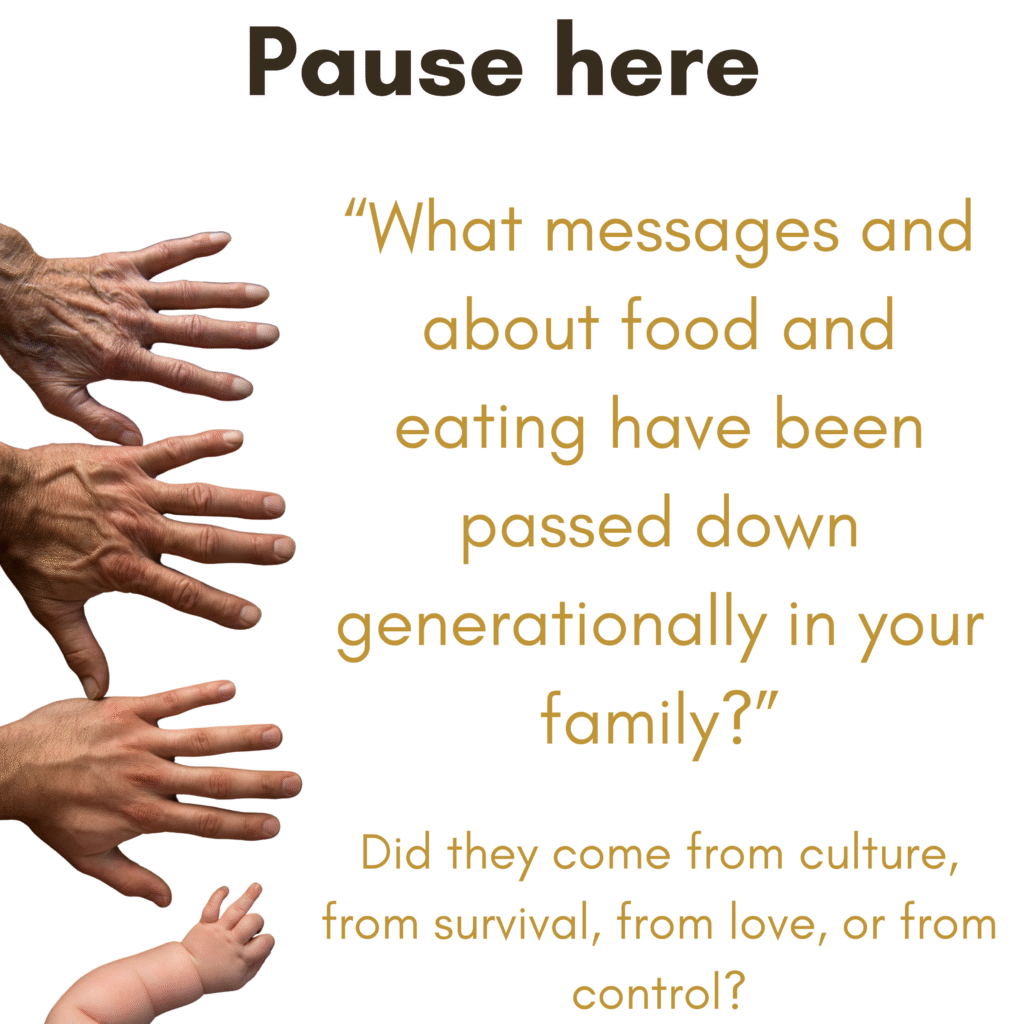
What messages about food and eating have been passed down generationally in your family?
Did they come from culture, from survival, from love or from control?
Felt safety isn’t just a feeling, it’s a real, embodied state. It’s the point at which, once the state of felt-safety is achieved, the nervous system stops bracing for harm and allows the body to relax, and for many Autistic people, that point is difficult to reach.
The threshold is narrow, and everything matters: the food itself, the noise in the room, the pace of the meal, the presence or absence of pressure, the emotional tone of those around us. Even small disruptions can push us back into defence mode: hypervigilant, masking, or shut down.
Felt safety around food isn’t just about not being physically forced. It’s about whether our body senses that it’s truly okay to let its guard down. Whether the moment is safe enough, predictable enough, kind enough that we don’t have to endure it just to get through. For many of us, due to the little validity and agency we experience generally, but also specifically around our relationship with food and eating, this sameness of food, of the routines we hold around food is the only reliable way to reach that state.
Because the cost of getting it wrong can be high. For some, it’s an immediate reaction: gagging, spitting, choking, bolting, crying. For others, it’s more internal: shutdown, dissociation, the slow withdrawal from mealtimes altogether. When a familiar food suddenly feels “wrong,” it’s not just a disappointment. It can feel like betrayal.
Like the last safe thing is no longer safe. And that betrayal is felt deeply in the body, it’s not always conscious or explainable. There might be no words for it. Only the refusal. Only the refusal again.
The body remembers.
One overwhelming bite, one forced meal, one encounter with an unexpected texture can linger for days, weeks, even years. The taste might fade, but the fear doesn’t.
And that memory shapes every future choice.
This isn’t stubbornness, it’s actually self-protection. It’s what happens when food stops being nourishment and becomes a warning sign.
Sometimes we don’t even refuse out loud.
We might eat with clenched teeth, hold our breath, and try to override the gag reflex. We might go silent. We might try to finish quickly. We might try to hide how hard it is. And because we eat, the struggle goes unseen, superficially the task is completed. But that silence isn’t consent, it’s a strategy. One shaped by earlier experiences of being punished, pushed, or praised for masking distress. It’s the same strategy that lives in the overarching development of masking: projecting acceptability in the hope of avoiding harm.
The grief that follows can be hard to name. The food that always worked doesn’t work anymore.
The body won’t tolerate it.
The smell is too strong.
The texture is off.
The routine is broken.
For some of us, this happens cyclically, with stress or hormonal shifts. For others, the loss becomes permanent.
What’s left is a narrowing of options, a deepening of shame, and a story told about us that says we’re being awkward or difficult.
We are not being difficult, we are experiencing difficulty.
That distinction matters.
When food becomes a site of sensory chaos, sameness is not pathology, its sanctuary. The problem is not the Autistic person who needs predictable food. The problem is the expectation that unpredictability is a neutral state.
That sensory variation is harmless.
That “just try it” is ever a low-stakes request.
And those expectations don’t arise in isolation but are upheld by neurological imperialism; this quiet, constant narrative that positions tolerance of change, sociability, adventurousness, and flexibility as the ideal, without considering any context other than its own privilege. This narrative is embedded in food norms, in school lunch policies, in therapy goals, in public health messaging, in the subtle hierarchy of what counts as “good eating.” It assumes sensory sameness is childish, that rejection is behavioural, and that control over food must always be handed back to the adult.
And when these expectations are enforced, whether through encouragement, exposure, or clinical intervention they carry epistemic violence. They disbelieve the body’s communication, overwriting refusal as non-compliance. They treat preference as pathology. And they punish the very instincts that keep us safe.
Over time, we learn not just to mask what our body feels, but to doubt it altogether. If we are told enough times that we are overreacting, too picky, too dramatic, the body’s signals start to feel unreliable: hunger, fullness, disgust, even satisfaction; these sensations become murky, hard to interpret. It’s not just that food becomes unpredictable, it’s that we become unpredictable to ourselves.
These responses don’t fall evenly. A white Autistic child who rejects dinner may be described as sensitive. A racialised Autistic child doing the same may be viewed as defiant, disruptive, or poorly parented. Sensory distress is not always granted credibility; it’s filtered through the gaze of power. The same gag reflex might be met with concern in one child, and suspicion in another.
And still, we try. We try to communicate what doesn’t feel right. We try to find a way back to foods we trusted. We try to tolerate what others say we should enjoy. But over time, many of us stop trying. Not because we’re stubborn. But because we’ve learned that our no will not be heard. We learn to internalise the failure. To believe that our disgust is unreasonable. That our desire for predictability is something to outgrow.
And many of us are taught that, explicitly. Again in scripts, slightly different from the first. Ones that don’t live in generational cycles, but live in societal expectations, manipulation, and gaslighting:
“You can’t just eat the same thing every day.”
“Don’t be fussy.”
“Try a bite, it’s not that different.”
“It’s exactly the same!”
These are lessons that teach us to override the body. To mistrust it. To betray it. And in doing so, they begin to fracture not only our food identity, but our communication identity, too. Because if your most basic expressions of distress are continually dismissed, if your needs are ignored, or over-ridden, why would you keep expressing them?
Food is a full-body experience. And for many of us, it’s also a full-body risk.
So when we cling to sameness, when we refuse the unfamiliar, when we mourn a once-safe food, we are not failing to grow. We are grieving. We are adapting. We are surviving.
Sameness is not rigidity; it’s the structure we build when the world offers none.
Pause Here and Ask:
What might you have communicated through food that others may not have recognised as language?
Think about moments of refusal, repetition, ritual or silence? What were you really saying? What did they infer?
Food is one of the first languages we speak and one of the first places we are silenced. If sameness brings sensory safety, then what we do with food is never just about taste, it’s about trust. And trust, for many of us, lives in how we’re allowed to communicate our needs.
We all communicate through food.
Sometimes with words. Sometimes with our eyes. Sometimes with the slow, steady push of a plate to the side. Sometimes with repetition, refusal, ritual. For Autistic people, especially those of us who are non-speaking, semi-speaking, or communicate through gesture, movement, or silence, food is often one of the earliest and most consistent ways we express need. The question is not whether we’re communicating, it’s whether anyone is listening.
For those who use AAC or other alternative communication systems, food communication may involve choosing a photo of a safe food, tapping a colour-coded card to express “too spicy” or “too squishy,” or using a scripted phrase that has become embedded into the rhythm of the routine. These are not just tools for communication, they are communication. Linguistic structures that carry emotional, sensory, and social meaning. So when they are ignored or overridden, it’s not only a preference being denied, but a language being erased.
Communication identity is the shape our expression takes in the world. It’s how we say what we mean, how we show what we need, how we make ourselves known. And like every other identity, it’s one shaped by power: by what is welcomed, by what is punished, by what others are willing to recognise as real. For many Autistic people, that recognition is hard to come by, especially at meal-times. The way we eat, or don’t eat, becomes one of the first places our communication is overwritten.
We say “no” by pushing a plate away.
We say “safe” by choosing the same meal again.
We say “I trust you” by eating beside someone we love.
We say “not today” by retreating to another room.
We say “this matters” by needing the same spoon, the same bowl, the same ritual that makes food tolerable.
But these expressions are rarely read as communication. They’re called avoidance. Or fussiness. Or control issues. Or disordered behaviour. Even when our refusals are clear, they are rarely granted meaning. Especially if we don’t say them in the way others expect to hear them.
And the cost of that dismissal is high. Because when communication is ignored, corrected, or punished, it doesn’t just disappear. It fractures. It burrows inward. It becomes something we stop trusting in ourselves.
For those of us whose language is pattern, rhythm and preference, food becomes a primary script. A way of saying: ‘This is me.’ But that script is often rewritten in real time:
“I don’t like it” is interpreted as being difficult.
“I’m not hungry” becomes laziness.
“I need it this way” is seen as controlling.
The message is constantly mistranslated and that mistranslation isn’t accidental, It’s cultural, it’s hierarchical, it’s imperialistic. It’s a function of whose communication is considered valid.
Pause Here and Ask:
How do you feel when other people watch you eat?
Is it something you notice? Does it change what or how you eat?
For many Autistic people, food preferences are not just habits, but part of how we structure our inner worlds. Monotropic attention means we thrive on predictability and depth. Eating the same food each day, using the same plate or cup, isn’t narrow-mindedness, it’s a way of reducing cognitive load, preserving energy, and sustaining trust in our environment. When those rituals are broken, it’s not just a sensory disruption, it’s a collapse of the scaffolding we use to hold ourselves together.
A sudden change in food can derail monotropic flow, knocking us out of the cognitive state we rely on to stay regulated. That disruption doesn’t just affect meal-time, it can destabilise our ability to stay present and safe for hours afterwards.
The same behaviour, whether that’s refusal, a repeated food, or a quiet withdrawal, will be interpreted differently depending on the body performing it. A white Autistic child might be called quirky or anxious. A Black Autistic child might be labelled rude, oppositional, or defiant. A neurotypical child who refuses a meal may be seen as expressing a preference. An Autistic child who does the same may be seen as refusing to comply. The same action filtered through power looks entirely different.
And that power extends beyond race or diagnosis. It sits in culture, class, language, gender. For some children, especially girls, the culture of a family’s belief systems plays a huge role. For those raised in deeply hierarchical, more patriarchal households, saying no to food might not just be frowned upon, it’s unthinkable. Three things are true at once: Food is a blessing. Food is respect. Food is obedience.
To refuse is to break the rules of belonging. And for many Autistic people, especially those who exist at the intersections of race, disability, queerness, and poverty, food is the one place where we are expected to perform gratitude even when our bodies are screaming. That expectation often disguises itself as care: “I made this for you,” becomes a guilt-stained directive, not an invitation. And to refuse, even gently, is framed as a personal insult, a betrayal.
Many of us were raised in households shaped by intergenerational food trauma where food refusal was punished, where acceptance was demanded, and where hunger or obedience became tied to survival. Parents who override our “no” might be repeating patterns once used against them. But repetition doesn’t make those patterns less harmful. It just makes them harder to see. These aren’t just habits. They are survival scripts, passed down in silence. And they are part of the reason why the refusal of Autistic people is so often disbelieved.
Things are changing as more parents learn and understand about their children’s neurology, and their own, and are starting to refuse themselves; but still Neurological Imperialism, this culture of conditioning reinforced by the systems outside our homes, is predominant and strong. The idea that we are allowed to have preferences, boundaries, or discomforts around food, or really any other part of life, is not universally granted. The ability to say no is not evenly distributed. For some of us, it’s a privilege we’ve never been offered.
And with food, when we do say no, or express discomfort, or ask for sameness we are not seen as communicating, we are seen as resisting, manipulating, and failing. That refusal is not read as an attempt to protect ourselves. It’s read as a challenge to authority. A failure to comply. A problem to be solved. And so the problem-solving begins with exposure therapy, reward charts, structured mealtimes, ABA-based feeding programmes, PECS token systems, “just one more bite.” All in the name of progress.
But progress at what cost?
Because what’s being asked of us isn’t just to eat. It’s to mask. To suppress our sensory truth. To perform acceptance. To sit still and swallow discomfort so someone else can feel reassured that we’re doing well. And when we manage that, we’re praised. For eating without fuss. For being “good.” For getting over it. But we didn’t get over it. We got quiet. And quiet is different from regulated. Quiet is different from safe.
We are not just eating. We are quietly disappearing.
This is what happens when communication identity is not affirmed.
Pause Here and Ask:
What were you taught about what your body should look like? How did food fit into that?
Whose standards shaped that message? Were they ever yours?
What sort of relationship do you have with your body now?
When our food language is constantly misread or ignored, we lose trust, and not just in others, but in ourselves.
We stop believing our own signals. We stop saying no. Not because the no has vanished, but because we’ve learned that saying it won’t matter. Or worse, it will invite more scrutiny, more pressure, more shame.
For many of us, that erosion begins early. And it doesn’t stay at the table. As the distress develops, the erosion follows us into clinical settings where our refusals and grasping for agency are pathologised as ARFID and other eating disorders.
Into classrooms where our food rituals are denied, mocked, or removed. Into feeding clinics where our communication is charted, shaped, and reshaped until it conforms.
Into family gatherings where we cause concern, invite micro-aggressions, are laughed at or excluded.
Into adulthood where we pretend to enjoy group meals, or say “I already ate,” or go hungry because explaining feels more exhausting than not eating at all.
This isn’t just food masking. This is communication masking. This is what it means to have your voice rewritten before you even had the chance to speak.
We must name what is happening here: epistemic injustice.
The discrediting of a person’s knowledge because of who they are.
When an Autistic person says: “I can’t,” and a professional hears “I won’t,” that is epistemic injustice.
When a racialised child says: “I don’t like this,” and an adult hears “you’re being disrespectful,” that is epistemic injustice.
When a non-speaking person uses gesture or silence to say no, and it’s ignored because it doesn’t count as language, that is epistemic injustice.
This injustice doesn’t just erase meaning; it actively replaces it by taking our communication and reframing it in terms that make sense to the dominant gaze. A parent might say, “They’re so controlling about food,” without ever asking why that control exists. A teacher might report that the child has a limited diet without noticing the child eats the same thing each day because it’s the only time they don’t have to guess what’s coming next. A clinician might suggest exposure, without wondering what the person has already been exposed to, and how many times they’ve been taught that their no doesn’t matter. The child who eats beige food every day may finally be diagnosed, not because their communication was heard, but because it became inconvenient enough to be medicalised.
This, too, is neurological imperialism: To deny someone’s food language is to deny the validity of their inner world. To say it’s less important than someone else’s reality, than someone else’s needs and values. It’s to deny their culture.
If you only listen when someone speaks your language, what truths are you willing to ignore?
When we talk about food and communication, we are also talking about trust. And when someone’s voice is constantly misread, mistranslated, or erased, that trust doesn’t just fade, it shatters. Not all at once.
Slowly.
Silently.
Bite by bite.
And we learn to adapt. To perform. To play the part. Some of us become the compliant eater, always agreeable, always grateful, always swallowing what we cannot name. Some of us become the oppositional one, the dramatic one, the picky one because at least that role is predictable, even if it draws punishment. Either way, we’re not being seen. We’re being managed.
Food is not just about management, it’s about meaning and meaning must be co-created, not imposed. It must be heard in many forms: in silence, in gesture, in repetition, in refusal. Communication is not the sole domain of speech. It lives in the body. In the pattern. In the pause. In the ritual. In the rhythm.
And when it’s safe, truly safe, food can also become a source of delight. Some of us share our favourite snack as a sign of trust. Some of us send food photos to loved ones to say: “this brought me joy.” Some of us create daily rituals that feel like home: the same tea at the same time, the same toast cut into triangles, the same playlist while we eat. These are not just habits. They are celebrations. They are acts of expression, of grounding, of connection. Food is not only a site of harm. It can be a site of joy, of culture, of belonging. But only when we are trusted to define that joy for ourselves.
So we must ask again:
What would change if we treated food behaviours as communication?
What if refusal was honoured as a boundary, not a problem?
What if sameness was read as a request for safety, not rigidity?
What if “I don’t like it” was enough?
Pause Here and Ask:
When was the last time food brought joy, not pressure?
Was that moment shared, solitary, structured or spontaneous?
What might open up if we stopped trying to correct people into speech, and started listening to the language they’re already speaking?
Many Autistic people arrive at the gates of eating disorder services without ever being recognised as Autistic. Instead, their sensory overwhelm is read as fussiness, their resistance is labelled oppositional, their distress is framed through anxiety, trauma, personality disorder, or parental dysfunction, everything but neurodivergence. Some receive diagnoses long after treatment begins, others never do. The signs were always there, but they were interpreted through someone else’s lens.
When the body says no to food, and no one listens to why, the response becomes something to fix, not something to understand. And particularly relevant to clinical settings is the bias of professionals who only view experience through the lens of their specialism, when everything they see is, to them, a facet of, a connection to the ‘disorder’ they perceive, so the box the person is placed in becomes the only borders to their experience.
The NHS describes ARFID (Avoidant/Restrictive Food Intake Disorder) as when someone avoids certain foods, limits how much they eat or does both. They go on to say that “Beliefs about weight or body shape are not reasons why people develop ARFID. But possible reasons for ARFID include negative feelings over the smell, taste or texture of certain foods, a response to a past experience with food that was upsetting, for example, choking or being sick after eating something, or not feeling hungry, or just a lack of interest in eating.”
ARFID, in particular, has become a container for complexity that few systems are equipped to hold. Defined by restriction, avoidance, or aversion that isn’t rooted in weight or shape concerns, it should, in theory, offer room for nuance. But in practice, it often functions as a label without context. A diagnostic placeholder for people whose eating doesn’t conform to normative expectations, yet whose distress doesn’t look culturally legible.
For Autistic people, especially those not yet identified, ARFID might be the first place their difference is clinically taken note of. But even then, it’s rarely recognised as meaningful. Sensory differences are often interpreted as irrational fears. Trauma adaptations are reframed as dysfunctional patterns. Attempts to protect the body are labelled as disordered. And what could be the beginning of understanding becomes yet another site of misrecognition.
This isn’t to say that ARFID as a diagnosis holds no value. For some Autistic people, especially those who have long been misrecognised, the label can offer not only language but legitimacy and a way to understand what once felt inexplicable. This can be a powerful, validating moment, especially when care recognises this and is person-led and non-coercive. It can also be the first time someone’s distress is taken seriously, or the beginning of understanding patterns that once might have felt like personal failure.
Diagnosis, when held with compassion and curiosity, can open doors, but diagnosis alone is not enough. When ARFID becomes a container that obscures more than it reveals, especially when stripped of trauma, sensory identity, and cultural context, it risks becoming another mechanism of control rather than support.
Many Autistic people describe the experience of ARFID not as fear of food, but fear of the unpredictable. A desire for structure and agency where they do not exist, may have never existed, unless imposed by outside institutions or systems. For those who can’t describe their distress in the expected terms, or who can’t perform urgency in a way that aligns with diagnostic thresholds, their suffering is overlooked entirely. Others are pushed to translate regulation into fear, or ritual into irrationality, simply to be believed. Legibility becomes a gatekeeping mechanism: if you don’t present distress in the right way, you don’t qualify for help.
What follows is often a push towards compliance. Exposure therapies. Reward charts. ‘Just try one bite’ plans. Behavioural goals focused on expanding the food repertoire. Sometimes this is done kindly, with encouragement and smiles. Sometimes it’s done bluntly, with pressure and discipline. But the underlying assumption is the same: That change is the goal.
That eating must be reshaped to look more typical.
That safety will come later once the body has adjusted.
But what if the body is not meant to adjust? What if the rigidity isn’t a refusal to grow, but a refusal to abandon the only thing that still feels safe?
These treatments often mirror the very dynamics that caused the fracture in the first place:
Coercion.
Suppression.
Disconnection.
The same child who was told they couldn’t leave the table until their plate was clean, who was praised for “trying” even when trying meant dissociation, is now being asked to do it again under clinical supervision. ‘Progress’ is measured by how well they can perform new behaviours, not whether those behaviours feel safe, chosen, or embodied. ‘Success’ is judged by visible outcomes: more variety, more sociability, more food groups. No one asks whether the person feels more connected to their body, or whether they’ve simply learned to suppress its signals more effectively.
When the body’s signals have been repeatedly ignored, invalidated, or punished, they begin to lose coherence. Hunger becomes indistinct. Fullness becomes confusing. Disgust becomes shame. Interoception becomes unreliable. The sensory information coming from inside and outside the body stops feeling like knowledge and starts feeling like a test to be passed. Embodiment itself becomes fractured, becoming something to manage rather than inhabit. And even the language to describe that experience is often missing, because no one ever gave it to us.
The cost of looking and ‘feeling’ better is rarely counted.
The praise that follows a “win” in treatment often drowns out the internal collapse that came before it. Shaking hands. Gag reflex overridden. Shutdown waiting on the other side of the appointment. These aren’t signs of recovery. They’re signs of survival… again. But survival is different from healing. And performance is different from presence. For many Autistic people, eating disorder treatment becomes another place they learn to project acceptability, wearing a new mask of progress over the same old wounds.
Praise, when unmoored from context, becomes another kind of pressure. It rewards disconnection. It silences struggle. What services call “improvement” is often just another learned mask, a well-practised mimicry of the behaviours that make others feel comfortable, while the internal experience remains unchanged. The act is rehearsed, palatable, familiar. It passes. And in passing, the distress disappears from view.
And that performance is racialised, it’s gendered, shaped by class, culture, language, and body. A white Autistic girl may be viewed as delicate and needing support. A Black Autistic boy with the same food patterns may be seen as aggressive, difficult, or neglected. A Trans Autistic teen may be questioned endlessly about their gender, while their sensory distress around food is dismissed as secondary or irrelevant. Being visible in the wrong body, in the wrong way, becomes dangerous. The same restriction that is read as a symptom in one person is interpreted as a threat in another. And the intervention that is offered, or withheld, depends less on need and more on how closely someone matches the system’s idea of who deserves care and what that care looks like.
To ask why someone isn’t eating is to ask what they are protecting. It’s to ask what has been done to their trust, their body, their sense of safety; it’s to recognise that sameness can be a life raft. That refusal can be a form of truth-telling. That ritual can be a sacred act of continuity in a world that constantly shifts beneath your feet. What if the narrow range of safe foods isn’t a deficit, but a scaffold? What if repetition isn’t a failure of flexibility, but a structure for survival? What if the body remembers more than the therapist does?
Restriction is not always an absence; sometimes it’s a boundary, or a signal, or a strategy. One that has been refined over years of trial, error, and self-preservation. And when that boundary is pathologised and becomes the target of treatment without ever being honoured as wise, the person holding it loses more than a food group. They lose the last bit of autonomy they had over what goes into their body.
The definitions of what counts as “normal” eating, what counts as “healthy,” are constructs reflecting dominant cultural narratives of Western, white, middle-class, individualistic ideals about food, behaviour, and success. In many other cultural contexts, eating with restriction or within ritual is not seen as disorder. It might be seen as spiritual, protective, communal.
Fasting, mono-eating, selective avoidance; these exist across cultures as valid expressions of embodiment, discipline, or care. In collectivist cultures, refusal may signal relational boundary rather than individual dysfunction. In others, sameness may reflect ancestral knowledge, ceremony, or cultural medicine. Yet across contexts, Autistic eating is too often interpreted only through Western clinical eyes. The mind-body-identity meaning is lost.
ARFID, like so many constructs in psychiatry, travels globally not as a shared understanding but as a westernised exported framework. It arrives in countries shaped by different relationships to food, body, and family. It shows up in NGO guidelines, clinical protocols, and cross-cultural research studies. It defines through that lens whose distress is visible enough to count, and whose needs are recast as dysfunction.
Pause Here and Ask:
How has your sensory experience shaped what you eat or avoid?
Have others understood this as a valid need or framed it as something to overcome? Autistic or not, have you even meaningfully considered yourself through this sensory lens before?
The same Autistic child in different countries may face vastly different interpretations of their eating, none of them shaped by their actual experience, but all shaped by what the system expects and is designed to see.
And not all distress plays out in clinics.
For every person receiving formal treatment for ARFID, there are countless others managing their eating differences at home, often in silence. Parents, caregivers, partners, friends, all trying their best, many of them afraid. For families, feeding can become fraught. They’re told to encourage flexibility, to promote variety, to avoid “enabling” behaviours. Some are praised when their child finally tries a new food, even if the child sobs in the car afterwards. Others are judged when they serve the same meal every day, accused of being indulgent or neglectful. The system demands consistency but offers none in return. And so, families improvise: reaching for love, routine, and anything that will bring peace to the table, even if it means copying the scripts they once survived themselves.
This isn’t a failure of parenting, it’s a failure of the systems that abandon them, that don’t recognise their needs. Most families are never offered a framework that centres Autistic food identity. They are not taught about sensory regulation, energy conservation, monotropism, interoception, co-occurring conditions, masking, or Autistic identity in any meaningful way. They are not given language for Neurodivergent trauma-informed feeding, or for recognising when distress is disguised as defiance. They are left to manage what others have misnamed, to hold the weight of uncertainty without any tools for attunement.
Many grieve in silence. Grieve the meals that always end in retreat. Grieve the joy they were told food and meals together are supposed to bring. Grieve the rupture that began with a well-meaning “just one bite.” They are navigating trauma without the name for it. Performing recovery because the world expects it. They are watching their child or partner vanish into a shrinking set of foods, unsure when to intervene or when to simply stay close.
In some households, food becomes a site of quiet repair.
In others, it becomes a war neither side wanted to fight. And in all of them, the underlying truth remains that food is not just nourishment, but a language, a relationship, a mirror, and a negotiation between survival, identity, and the hope of being understood.
To talk about ARFID is to talk about that negotiation. Not just in clinics, but in kitchens. Not just in research papers, but in the quiet moments when a plate is pushed away, or a meal is eaten in silence, or a new food is greeted with anxiety instead of celebration. Reclaiming Autistic food identity means holding families too. Not in judgement, but in collective unlearning. It means naming the harm, and offering something else: language, context, consent, care. Because food does not begin with behaviour, it begins with the body. And every body, every single one, deserves to be trusted. Every body deserves to be heard.
Survival may have shaped our eating, but it does not define its future. Beneath restriction lies memory, meaning, and the potential for something softer, something built on trust, not control.
For Autistic people, there is a particular kind of grief that comes not from a single moment, but from the slow accumulation of being misread.
For many of us, that grief is bound up with food.
Not just in memories of specific meals, but in the atmosphere around them: the pressure, the pretending, the loneliness of being asked to betray our own bodies for the comfort of others. Often, this grief is unnamed. It lives in the gaps between what we could express and what was heard, between what we needed and what was safe to need.
We try to override our own instincts in exchange for praise. We shrink our preferences, our discomfort, our honesty. We say thank you with our mouth full of something we cannot stand. We try not to gag. We try not to cry. We try to survive the bite so we can leave the table with a shred of dignity intact. And when we can’t, when we break down, shut down, or say no too loudly, we are reminded again that this is not about what we feel, but how well we hide it.
This isn’t just shame we generate ourselves, this is stigma, deeply implanted, repeated, rehearsed. It’s the social consequence of not conforming, the emotional tax of being watched, judged, or corrected. It’s not a feeling, it’s a warning system, trained into us by a world that only rewards palatable distress.
That stigma becomes internal. Shame becomes a second skin. We learn to carry it in our posture, in our speech, in the way we apologise for being full after two bites, or not hungry at all, or only able to eat in silence. We learn to second-guess our needs. To eat what is offered, not what is safe. To be polite, not present. To treat refusal as failure, and sameness as something we must outgrow. We lose trust in our own hunger, and in doing so, we lose a part of ourselves.
Some of us grieve what we did to survive. The years we spent eating as performance, not pleasure. The times we said yes with our mouths while our bodies screamed no. The rewards we were given for hiding our distress, and the parts of us that disappeared in exchange. Others grieve the role they were asked to play. The caregiver whose good intentions were weaponised by expert scripts. The parent who followed advice to ignore the distress, to outlast the refusal, to praise the compliance. The family who believed they were helping when they were reinforcing the very dynamics their child was trying to escape.
And some of us grieve the joy we never got to feel over the meals we never felt safe enough to enjoy, the curiosity that was punished, the tastes that were drowned in pressure or performance. We grieve the connection we couldn’t make, the rituals we weren’t invited into, the quiet pleasure of food that was always one step out of reach. And yet more grieve for the fact that they were never allowed to consider food as perfunctory, as fuel, purposeful only to keep the body alive. With no interest in variety, sameness co-existing with consistency, yet an assumption from all around that food should be ‘tasty’ and ‘enjoyable.’
For Autistic people, this grief rarely stays contained. It spills into every place where our identity has been fractured by performance. We grieve our communication, distorted by translation. We grieve our movement, moulded by restraint. We grieve our interests, reframed as obsessions. We grieve the parts of ourselves we were told to suppress for the sake of being acceptable. Neurological imperialism does not stop at the dinner table, it trains us to live apart from our own bodies, to experience even the most basic expressions of self as transactions, not truths.
And for those of us whose food identities are bound to culture, whose spices were too strong, whose textures too strange, whose rituals too loud or too silent; the grief takes on another shape. We learned to make our hunger small, our spices invisible, our lineage edible to whiteness. The grief of that is not personal, but structural, patterned, and global. It’s the grief of having to make ourselves digestible in order to be accepted.
This grief isn’t weakness, only clarity. It’s what happens when we finally recognise the cost of fitting in. It’s what comes after the performance cracks, and the silence lifts, and we begin to feel what we were never allowed to name. It’s not ours alone though. This grief moves through communities, through families, through generations denied the space to eat on their own terms. A sign that we remember who we were before the rules were written for us.
But grief isn’t where the story ends. Because even after everything, we are still here. Still hungry. Still trying to remember what food can be when it belongs to us.
Pause Here and Ask:
Where does food sit within your understanding of Autistic identity?
What would you change if we saw eating patterns not as problems, but as expressions of how someone experiences the world?
Reclaiming food identity does not mean returning to a table that has only ever been a place of surveillance.
For many of us, the idea of shared meals still feels unsafe. Some of us eat alone, eat in silence, eat only certain things, eat at night when no one is watching. Some of us don’t eat much at all. Reclaiming isn’t about fixing that. It’s about refusing the narrative that says something is broken.
Because what if there is no universal table to return to? What if the table itself (Who built it? Who sets it? Who is invited to it?) has always been the problem?
For all of us, food identity is deeply personal. But how we’ve been allowed to eat, speak, refuse, or take joy has never been separate from our broader identity – itself shaped by disability, race, class, gender, or culture. Some of us were punished more harshly. Some of us were never believed. Some of us still carry the silence of being misread, misunderstood, or made to comply for survival. We don’t all reclaim from the same place, and we’re not all reclaiming the same things.
What we are reclaiming is not etiquette, or social ease, or palatability. We are reclaiming the right to define what food means in our lives. The right to say “no” and mean it. The right to say “yes” and not have to explain why. The right to eat the same thing for weeks, or only white foods, or meals made of textures that others find strange. The right to not eat at all sometimes, without our needs being overwritten by fear or control.
This is part of the slow unravelling of the mask. For so many of us, food has been another way of projecting acceptability: eating to avoid judgement, discomfort, or rejection. We smiled through gags, chewed past panic, said “yummy” when it hurt. The cost never visible, but we carried it anyway. Reclamation is the decision to start listening to ourselves.
This is done in partnership with broader work, recognising the role that (the lack of) self-understanding, agency and autonomy play in someone’s life. The recognition of stigma, of systemic and interpersonal biases, the recognition of, and working through, trauma.
This reclamation begins with boundaries and consent, not just the absence of force, but the presence of choice. Autonomy that doesn’t have to be earned through good behaviour or expanded diets. Communication that doesn’t have to be translated to be trusted. Bodies that don’t have to perform distress in the right way to be believed.
It also begins with curiosity.
Not the clinical kind that picks us apart, but the kind that wonders with us. That asks:
What does safety taste like?
What texture feels like home?
What if food was not a battleground but a conversation; an ongoing one, without pressure, without an endpoint?
And it begins, too, with culture.
With the return to spices and rituals that were shamed out of us. With the foods that connect us to our ancestors, our languages, our traditions. With the quiet defiance of seasoning our rice the way our grandmother did, even if no one else at the table understands it. For some of us, reclaiming food identity means unlearning the shame of “too much” or “too different.” For others, it means letting go of the fantasy that food must be communal at all or that food even has to serve a purpose other than fuel.
Reclamation is not about assimilation into someone else’s comfort, it’s about finding our own.
Reclamation doesn’t erase grief. It grows alongside it. We can mourn the table that harmed us and build a new one from what we choose to keep.
There is joy here, though it’s not always loud. There is joy in soft foods and sameness, in weird combinations that no one else understands but feel exactly right in our mouths. Joy in the rituals we invent for ourselves, the ones no one taught us, but we somehow always knew. Joy in the moment we stop trying to explain and start trusting that our body is telling the truth.
What looks like rigidity to others may be a carefully protected flow state, a sensory lifeline that helps us stay regulated in a world of interruption. What looks like avoidance may be an act of preservation. What looks like excess may be celebration. There is nothing universal about how reclamation shows up and nothing broken in that.
Some of us will reclaim alone. Others will find it in family rituals newly reimagined, in chosen community, in cultural traditions revived, or in therapeutic spaces that centre consent, culture, and lived experience. Reclamation doesn’t have to be solitary. It can be shared, co-created, and held with others who understand.
There is no single way to reclaim food identity because it’s as individual and complex as we are. What matters is that we are no longer swallowing someone else’s rules we never agreed to.
Pause Here and Ask:
What would it look like to rebuild trust with food?
Not just nutritionally, but emotionally, relationally or culturally? Where would you start?
It was never about the chicken nuggets.
That tired trope of the Autistic child who only eats beige food has become a cultural shorthand, a punchline, a lazy symbol of rigidity and fussiness. But we know better. We’ve always known. Because for us, those nuggets, or their equivalents, were never just food. They were safety. Predictability. A texture we could trust. A flavour that didn’t lie. A shield against overwhelm. A ritual that anchored us when everything else fell apart. They were control in a world that gave us none.
And what of the fact that chicken nuggets don’t exist in all cultures? Not only is it a trope, but it’s also a deeply UK and North American driven one. Que surprise: the two places who have gotten to define not only the autism narrative, but the psychiatry narrative, the eating disorder narrative, so many narratives, keeping white, patriarchal, non-disabled, straight, Christian experiences as the centre of all existence. Imperialism rears its head once more. Cultural and neurological.
The nugget trope, like so many of these flawed stories told about us, was never about understanding, it was about containment and ridicule dressed up as concern. A subtle form of shame passed from adult to child, from clinic to classroom, from one generation to the next. A running joke, dripping not with frying oil, but stigma.
So, what is important here? Getting Autistic people to eat “better” or asking who gets to define what better even means?
Who decides what is healthy, or acceptable, or real?
Who decides whose hunger counts, and whose doesn’t?
Who decides whose food is labelled “safe,” and whose is pathologised as a problem to solve?
This piece can only scratch the surface. The real work, the unlearning, the repair, the reclaiming, that all needs time, tools, and community.
Reclaiming food identity is not about eating more broccoli, or mastering cutlery, or joining the dinner table. It’s about coming home. To our bodies. Our sensory truths. Our families and cultures. Our rituals and refusals. Our right to joy, to sameness, to silence. Our right to be nourished on our own terms, in our own languages, without needing to justify our survival.
This has always been about more than food. It’s about dignity. It’s about recognising how neurological imperialism has shaped what we’ve been allowed to eat, express, demand, and reject. And it’s about undoing that harm together.
That’s the real act of nourishment. It’s not what’s on the plate, but whether we were allowed to choose it, refuse it, or share it without shame?
Reclaiming Autistic Food Identity: A 4 part training with Kieran Rose and Naureen Hunani, RD
This article is only the beginning…
There is so much more to say about masking, trauma, identity, culture, sensory survival, and the deep emotional terrain of feeding and being fed.
That’s why I’m delighted to be exploring these questions in full collaboration with Naureen Hunani in four-part training series, Reclaiming Autistic Food Identity. Together, we’ll dive deeper into the histories, tensions, grief, and joy that shape our relationships with food. Not to fix them, but to honour them. We’ll bring lived experience, clinical insight, cultural resonance, and radical curiosity to a conversation that too often starts with assumptions instead of listening.
You’re invited. Not to learn how to get someone to stop eating nuggets. But to ask: “What does an Autistic food identity mean? What does it have the potential to become when we stop trying to correct it and start listening instead?”
Across four, 90 minute sessions, this training will center Autistic culture and food identity, offering a critical reframe of how Autistic eating experiences are understood and supported. It is grounded in compassion, consent, and cultural context.
The training comes complete with slides, a workbook and an ebook version of my article ‘Reclaiming Autistic Food Identity: Feeding Shame and Swallowing Stigma’ (the article you have just been reading).
Find out more here: Reclaiming Autistic Food Identity Training
If you’ve found this article useful you can support my work by donating any amount from $3 (about the same as a coffee – mine’s a caramel latte please!).
I know not everyone wants, or needs, one of my training courses, but I often find people will read one of my free articles and want to say ‘thank you’. And this is a really easy way to do that. It also supports me to keep being able to create new, free content and keep my older, free content up-to-date. It also allow me to keep my website ad-free. My Autism FAQs page is a good place to start if you’re new to my work and want to explore more.
Thanks for you support – it means the absolute world. Kieran x
Keep in touch with Kieran Rose, The Autistic Advocate
Training and ebooks from Kieran
I have a full range of autism training and ebooks on my website; starting from just a few dollars and all priced to be affordable.

Got more questions about Autism?
If reading this article has given you more questions then my Autism FAQs is a great place to point you in the right direct to get answers (and most of where I direct you is to free-to-access resources!).
