I haven’t had the capacity to speak publicly about Uta Frith’s latest intervention, the media frenzy around it, or the wider political narrative gathering apace around autism, diagnosis, education, welfare, disability and support.
That doesn’t mean I haven’t noticed what’s happening.
The same ideas keep proliferating: that too many people are being recognised; that some of us have somehow talked ourselves into being Autistic; that our accounts of our own lives are less credible than the interpretations of people who have never lived them; that legitimacy still belongs to institutions, professions and systems rather than to Autistic people.
Those ideas aren’t confined to newspapers, television programmes or academic journals. They fundamentally shape who is believed, who is diagnosed, who receives support, who is regarded as ‘properly’ disabled, who ‘deserves’, and who is written out of the story completely.
In response, there is an urge to compete, to push back, to stamp, to scream, to debate, to rail against the injustice.
I learnt myself the hard way, long ago, that good people put themselves into the firing line of journalists and reporters, with the absolute best of intentions, hopeful that a five-minute segment, or a 25 minute interview condensed into a paragraph in a paper or magazine, will change the minds of millions.
But it won’t.
Not on its own.
These are not the long, ongoing, in-depth and meaningful conversations that are needed; conversations held with curiosity, honesty and reflection. The media format isn’t designed to provide those conversations. It is designed to produce conflict, spectacle and uncertainty. It’s superficial by design. It’s the circus for the mob where Autistic people are the animals being beaten, muzzled and caged for the pleasure of the masses.
There will always be a Frith.
There will always be a representative of power wielding misinformation and ignorance like a bludgeon.
There will always be a hungry media ready to suck up whatever antiquated, scientifically unfounded, opinion-led and stigmatising drivel gets thrown out there, as long as it feeds historical bias and offers people a momentary sense of power through the policing of those who hold even less.
A brief sating of the fear of powerlessness.
The weight of history cannot be reframed in a heartbeat when that history is drenched in blood, stigma and ingrained privilege.
This is a war of attrition.
A war that has costs, with chronic collateral damage.
This is a movement of civil rights.
A movement measured in decades and likely centuries, not minutes and moments.
It is a minority group struggling not against a majority of people, but against a majority ideal.
Ideals can change, but that takes time, patience and collective effort.
It may not be glamorous, but the steady, quiet, rebellious work is the sustainable, ground-shaking work.
Neurological Imperialism is not defeated by isolated acts of heroism.
Empires don’t crumble overnight.
They are destabilised by the constant chipping away of their foundations.
One of those foundations is, quite literally, the words we use.
When people with authority try to define us from the outside, language becomes one of the places in which we defend ourselves.
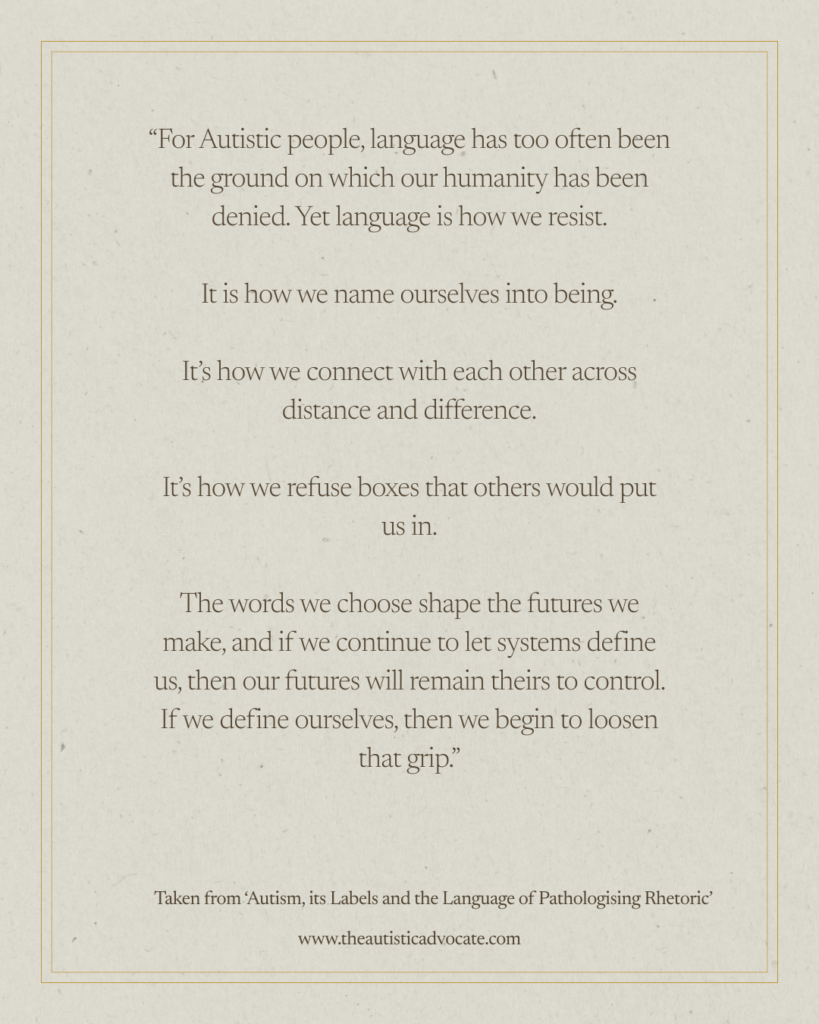
Naming ourselves is neither fashion nor confusion, and it is not the result of contagion. It is recognition. It is a refusal to let other people decide the boundaries of our humanity and our very existence.
The words in this quote of mine speak to that.
The boxes placed around us are shackles of power and control, and there is often little we can do to prevent those boxes being imposed.
But the ways in which we define and identify ourselves create connection and strength.
They are part of the quiet rebellion.
Those who seek to control us cannot take that away, however hard they try.
Define yourself. Don’t be defined by government, psychiatry, psychology, or Uta fucking Frith.
Think.
Critique.
Learn.
Pick your battles.
Save your spoons.
Connect.
Collect.
Organise.
Reflect.
Chip, chip, chip away.
For this too shall pass, and the ebbs and flows of this and the other interconnected rights movements will continue on, until there is nothing but rubble, and something new and evolved and inherently more humane can emerge.
I don’t currently have the capacity to write the fuller response this deserves. For now, these words can stand in its place.
Further Reading
The quite in the image was taken from my article; ‘Autism, its Labels and the Language of Pathologising Rhetoric’
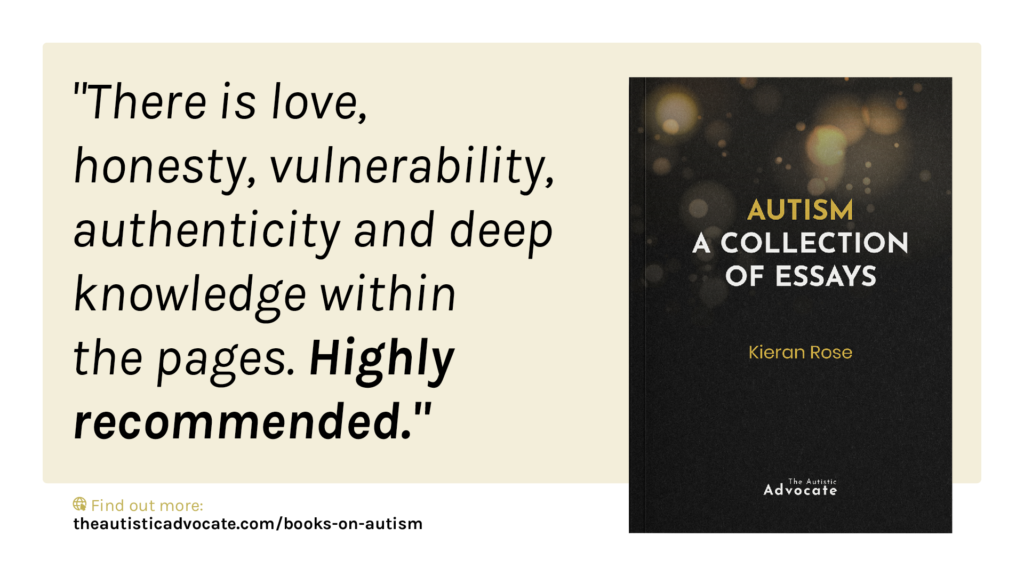
These essays are contained in my book, ‘Autism: A Collection of Essays’ along with 14 other essays from my blog. Including a new introduction, preface and a Foreword from Dr Amy Pearson. Find out more here; Autism: A Collection of Essays
If you’ve found this article useful you can support my work by donating any amount from $3 (about the same as a coffee – mine’s a caramel latte please!).
I know not everyone wants, or needs, one of my training courses, but I often find people will read one of my free articles and want to say ‘thank you’. And this is a really easy way to do that. It also supports me to keep being able to create new, free content and keep my older, free content up-to-date. My Autism FAQs page is a good place to start if you’re new to my work and want to explore more.
Thanks for you support – it means the absolute world. Kieran x
JOIN KIERAN’S MAILING LIST (for infrequent, but useful, updates!)
And, as a thank you for joining, you’ll get a 10% off code emailed to you which you can use on my on-demand autism training (including my flagship training The Inside of Autism).
You’ll also receive a free, printable poster of my ‘Life Is Hard’ post and a reading list of all 60+ of my articles.
Training and ebooks from Kieran
I have a full range of autism training on my website; starting from just a few dollars and all priced to be affordable.

Got more questions about Autism?
If reading this article has given you more questions then my Autism FAQs is a great place to point you in the right direct to get answers (and most of where I direct you is to free-to-access resources!).
